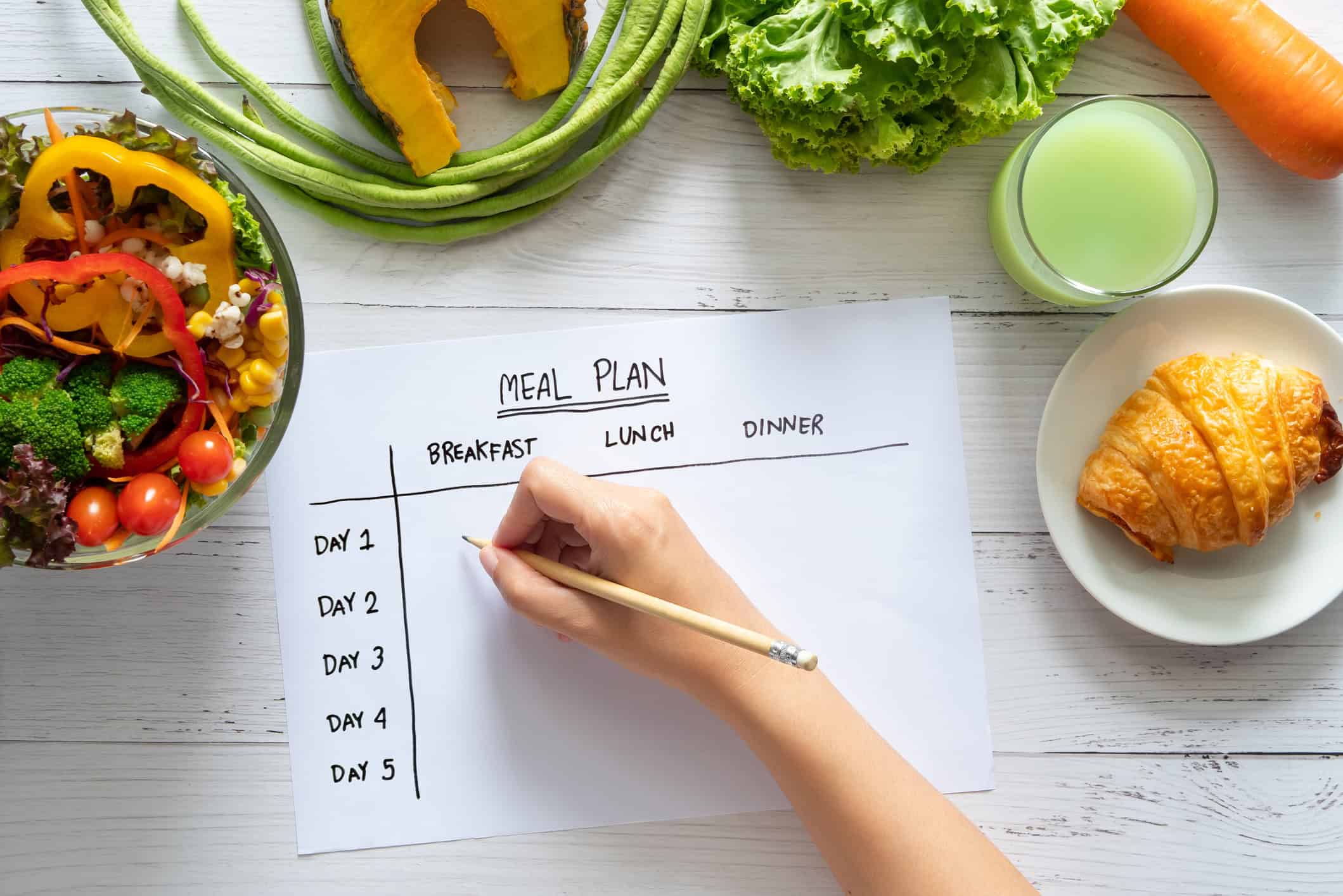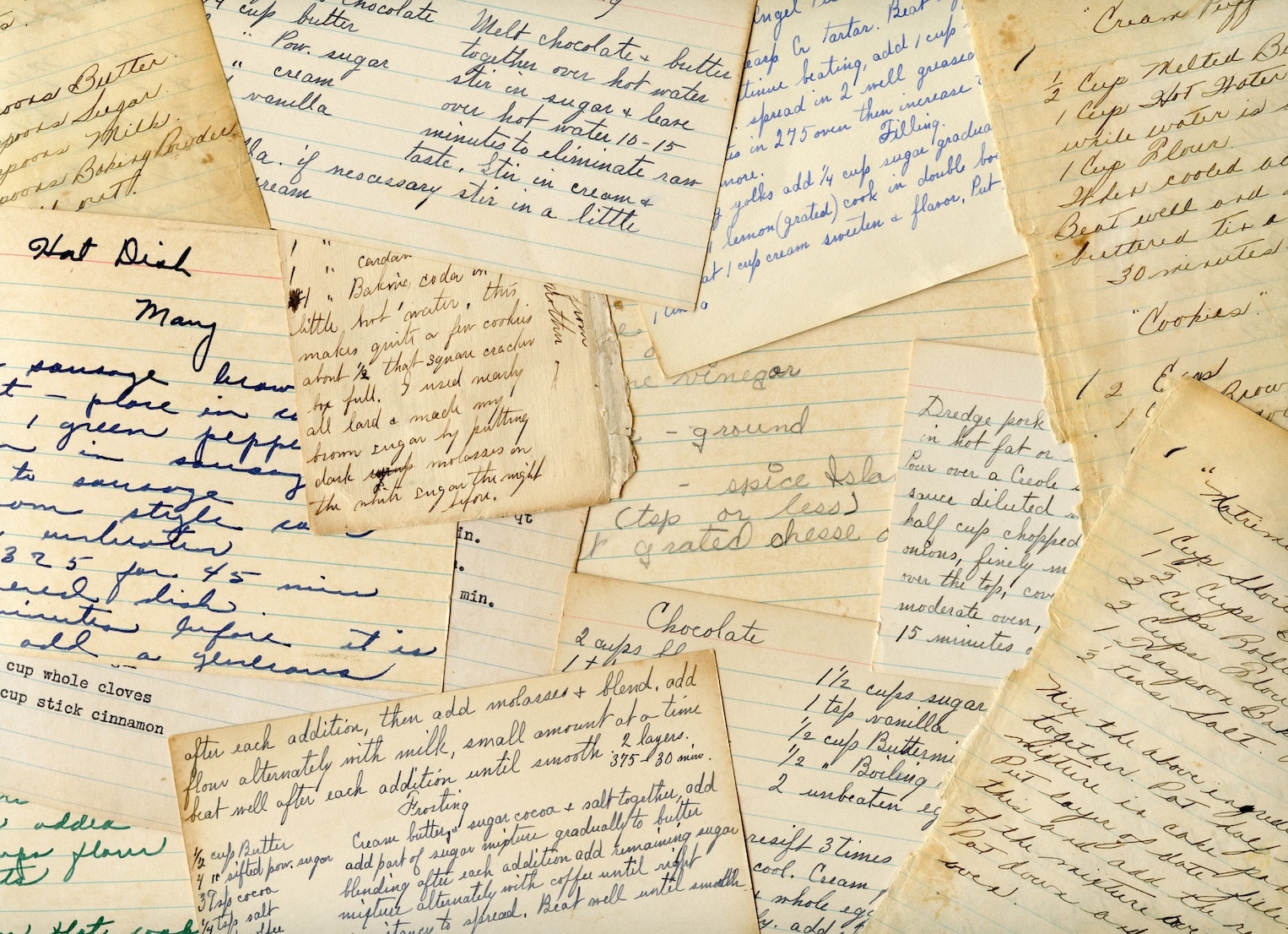



Dinner falls apart in a familiar way. A recipe is saved on Instagram, another is buried in a TikTok folder, one favorite is on a stained index card, and the shopping list lives in someone's notes app. At 5:42 p.m., meal planning is no longer a plan. It is a scavenger hunt.
Busy families usually do not need more recipe ideas. They need one reliable place to keep the recipes they already use, the plan for the week, and the grocery list that supports it. Without that system, even good intentions break down by midweek. You end up re-deciding dinner every night, buying the same ingredients twice, and forgetting the meals your family will eat without a fight.
A meal plan that lasts has to work on rushed Tuesdays, late practice nights, and the evenings when nobody has the energy to start from scratch. It also has to make room for repeats. In real homes, the winning plan is rarely a brand-new seven-day menu. It is a short bench of dependable meals, a few flexible backups, and a digital setup that makes those options easy to find.
That is the shift that makes meal planning stick.
Paper menus can help for a week. A durable digital system helps month after month because it keeps your recipes, notes, categories, and shopping list in one place. Once everything has a home, you stop relying on memory and start reusing what already works.
Table of Contents
- Set Realistic Goals for Your Meal Plan
- Build Your Central Recipe Library
- Design a Flexible Rotating Menu
- Streamline Your Prep and Grocery Shopping
- Essential Tips for Picky Eaters and Packed Schedules
- Frequently Asked Meal Planning Questions
Set Realistic Goals for Your Meal Plan
A good meal plan doesn't prove that you're organized. It reduces stress at dinner.
That sounds obvious, but a lot of meal planning for busy families falls apart because the target is wrong. Parents start with an ideal week: seven balanced dinners, several new recipes, no takeout, and a fridge full of produce that somehow all gets used. Then school pickup runs late, one kid hates the casserole, and Thursday becomes eggs or drive-through.
The better standard is consistency. Peer-reviewed research shows a strong link between meal planning skills and healthier family habits, with planners significantly more likely to prepare over 50% of their evening meals at home, according to this PubMed Central study on family meal planning and mealtime routines. That's the payoff. Not perfection. More home-cooked dinners, more often.
Decide what success actually means
For one family, success might mean cooking one more dinner at home than last week. For another, it might mean ending the 5 p.m. scramble. For a family with sports, shift work, or therapy appointments, success may be knowing which nights are planned and which nights are intentionally easy.
Try goals like these:
- Reduce decision fatigue: Dinner is chosen ahead of time, even if the meal is simple.
- Lower last-minute stress: Ingredients are already in the house for the nights that matter most.
- Make family dinners more consistent: You don't need every night. You need enough nights to create a rhythm.
- Stop wasting effort: Fewer abandoned meal plans, fewer forgotten ingredients, fewer random recipe saves you'll never find again.
Practical rule: If your plan creates more pressure than relief, it isn't a good plan yet.
Start smaller than you think
Most families do better when they plan only the dinners that need planning. That usually means the busiest weekdays. If you're new to this, start with a short list of reliable meals and leave space for leftovers, breakfast-for-dinner, or an eat-out night.
A realistic meal plan usually has these traits:
- It matches the week's energy level. Nobody should be sautéing three components on the day everyone gets home late.
- It uses repeat meals on purpose. Familiar dinners lower resistance from kids and lower effort for adults.
- It leaves room for disruption. One missed plan shouldn't wreck the rest of the week.
Families stick with meal planning when it feels lighter than winging it. That's the benchmark worth aiming for.
Build Your Central Recipe Library
The weekly plan only works if your recipes are easy to find when you need them. That's where most systems break.
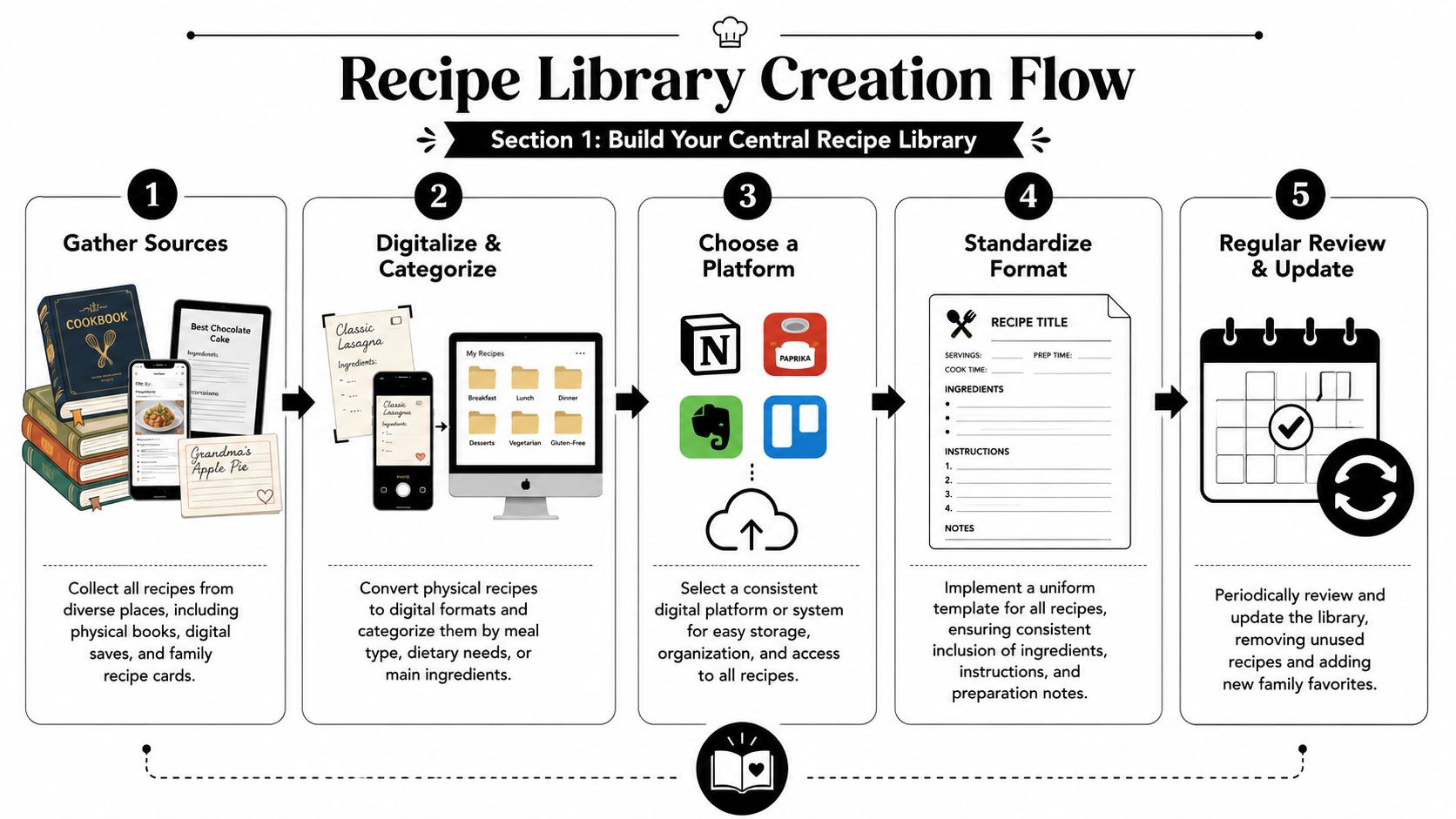
Modern recipe discovery is fragmented. People save dinner ideas from social media, websites, texts from friends, old cookbooks, and handwritten cards. Meanwhile, U.S. adults spend over two hours daily on social media, and recipe discovery is increasingly scattered across those platforms, as noted in this meal planning guide focused on recipe fragmentation. If you don't capture those recipes into one durable library, your future self keeps starting from zero.
Start with recovery, not organization
Don't begin by building the perfect taxonomy. Begin by rescuing the recipes you already use or keep trying to remember.
Pull from every source you use:
- Social saves: Instagram posts, TikTok videos, Facebook links, Pinterest pins
- Web recipes: browser bookmarks, open tabs, emailed links
- Paper recipes: cookbook pages, printed clippings, recipe binders
- Family recipes: handwritten cards, notebook pages, text messages from relatives
This is the part many families skip. They keep "discovering" new recipes but never finish the job of storing them. If you want a practical walkthrough for that cleanup step, this guide on how to organize recipes for meal planning success is useful.
Use a format you can search later
A pile of digital files isn't a library. A library lets you find "fast chicken dinner," "freezer-friendly soup," or "birthday pasta" without scrolling for ten minutes.
Your recipe records should include enough detail to help on a busy night:
- Recipe name
- Source or original context
- Main ingredients
- Meal type
- Time or effort level
- Notes from real life, such as "kids eat this," "double it for leftovers," or "make on Sundays"
Photos matter too. A photo of Grandma's card preserves the original. Typed notes make it searchable. Both can live together.
Save the recipe in the form you'll actually use later, not the form you happened to find it in.
Pick one home for everything
The tool matters less than the rule. One home. Every recipe.
Some families use Notion or Evernote. Others prefer a dedicated recipe app. Trello can work if you're naturally visual. What matters is that the system handles three jobs well: capture, search, and access during cooking. A dedicated tool like OrganizEat can do that by saving recipes from social platforms and websites, storing photos of handwritten or printed recipes, and keeping everything searchable across devices with grocery list and meal planner features.
A reliable central library should let you:
- Capture recipes quickly: one tap or one photo, not a long manual process
- Tag recipes flexibly: by protein, dietary need, cooking method, or family member
- Access recipes offline: useful when the original post disappears or your signal doesn't cooperate
- Add personal notes: because "use less salt" and "serve with rice" are the notes that make a recipe repeatable
Regular review keeps the library useful
A central recipe library shouldn't grow forever without editing. If a recipe looked good online but nobody wants it twice, archive it. If one meal rescues Thursday every week, tag it clearly and move it into your core rotation.
A simple review habit helps:
- Keep favorites visible
- Remove one-hit wonders
- Retag meals that fit new routines
- Mark seasonal recipes so they return at the right time
Once your recipe library is stable, meal planning stops being a hunt. It becomes a short selection process from meals your family already knows how to eat.
Design a Flexible Rotating Menu
Tuesday at 5:20 p.m., one kid needs to be at practice by six, another is melting down because the pasta shape is wrong, and the recipe you meant to make is buried in a saved Instagram post. A rotating menu fixes that problem because dinner stops depending on memory, inspiration, or a perfect week. It runs from a system.
The families who stick with meal planning usually stop chasing novelty. They repeat a manageable set of dinners, leave room for leftovers or takeout, and save experimentation for nights with more time. The difference between a paper menu that lasts a week and a system that lasts all year is digital organization. Your recipe library should feed your menu, not sit off to the side.
Build categories, not a rigid calendar
Theme nights still work, but they work better when each theme points to a saved category in your app. Monday is not "spaghetti forever." Monday is "pasta," with three or four recipes already tagged by cook time, kid acceptance, and ingredient overlap.
A practical rotation might look like this:
- Monday: Pasta or noodles
- Tuesday: Tacos, bowls, or quesadillas
- Wednesday: Slow cooker, sheet pan, or freezer meal
- Thursday: Leftovers, remix night, or breakfast for dinner
- Friday: Pizza, flatbreads, or a family favorite
- Weekend: One higher-effort meal and one flexible meal
That structure cuts decisions fast. You are not searching the internet on Wednesday. You are opening your "sheet pan" tag and picking the option that fits the time you have.
Keep a short bench for each category
A rotating menu gets stronger when each category has a small bench of repeatable meals. I aim for three to five dinners per category. That is enough variety to avoid boredom and small enough that the meals stay familiar.
For example:
- Pasta: baked ziti, pesto tortellini, spaghetti with meatballs, peanut noodles
- Taco night: chicken tacos, burrito bowls, black bean quesadillas, nachos
- Low-effort tray or pot meals: sausage and vegetables, sheet-pan chicken, chili, slow cooker soup
Store those meals in your recipe app with tags that matter in real life: 20 minutes, freezer-friendly, no complaints, packed-lunch leftovers, and picky-eater safe. If a child has sensory or dietary needs, add a separate tag for that too. Families handling more specific food restrictions may benefit from targeted planning models such as Guiding Growth's autism meal plan.
Plan for two versions of the week
This is the part many parents skip. A durable menu needs a normal version and a survival version.
The normal version includes your usual categories and one meal that takes a bit more effort. The survival version uses the same categories but swaps in faster backups: frozen ravioli instead of homemade pasta sauce, taco bowls instead of enchiladas, grilled cheese and soup instead of the recipe you bookmarked three months ago and still have not made.
That swap should happen inside the same system. If you use OrganizEat or another digital planner, save a "chaos week" tag or a separate board with your fastest reliable meals. Then nobody has to reinvent dinner while standing in the kitchen at 6 p.m.
Sample 1-week flexible rotation
| Day | Dinner Idea | Notes |
|---|---|---|
| Monday | Pasta with roasted vegetables | Good use of produce that needs to be cooked soon |
| Tuesday | Tacos or burrito bowls | Easy to separate components for different preferences |
| Wednesday | Sheet-pan chicken and potatoes | Minimal cleanup on a crowded night |
| Thursday | Leftover bowls or grilled cheese and soup | Built-in buffer for schedule changes |
| Friday | Homemade pizza or flatbreads | Familiar and easy to customize |
| Saturday | New recipe night | Better time to test something from TikTok or Instagram |
| Sunday | Slow cooker meal or roast | Cook enough for leftovers |
The table is a template. Real life will interrupt it. A good rotating menu survives interruptions because the categories stay stable even when the exact meal changes.
Use rotation rules your family can actually follow
Keep the rules simple:
- Assign each saved dinner to one or two categories.
- Mark the true cook time, not the fantasy cook time from the recipe.
- Match easier meals to your hardest days.
- Leave one dinner open every week.
- Review the rotation monthly and remove meals nobody wants repeated.
That last step matters. A rotation should get tighter over time. If a meal looked good online but never works on a school night, it does not belong in the weekday plan.
A digital menu also makes shopping easier because repeated meals create repeated grocery patterns. Once your categories are stable, it is much easier to build a repeatable list using a few grocery shopping tips for busy families instead of starting from scratch each week.
Streamline Your Prep and Grocery Shopping
A meal plan isn’t finished when you pick recipes. It’s finished when the ingredients are in the house and the hard parts are already done.
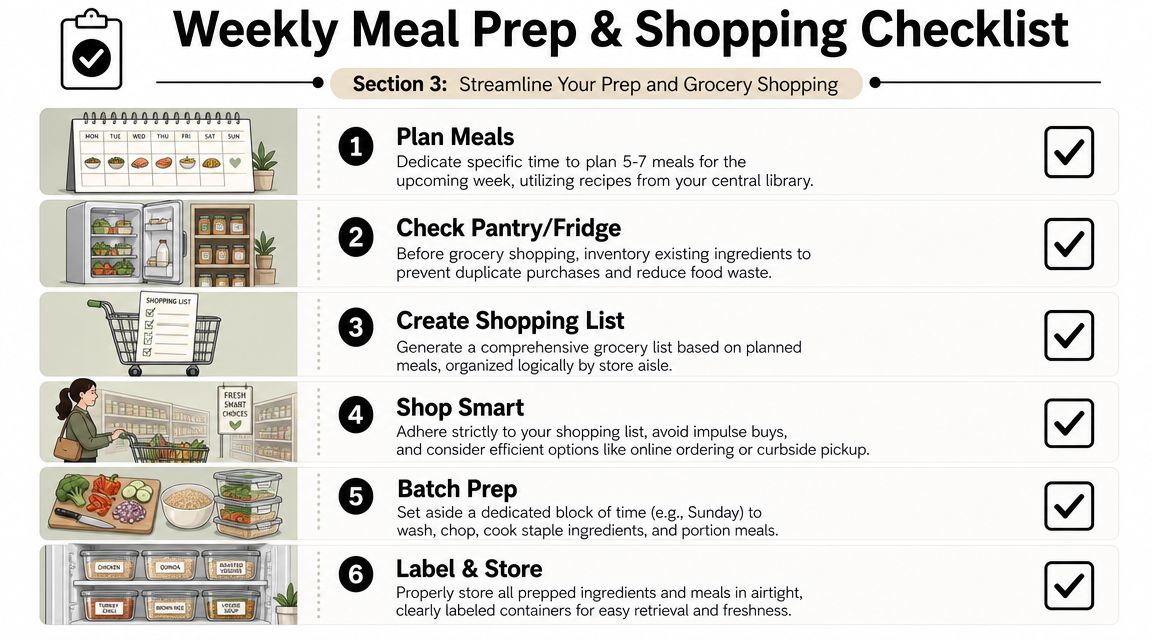
Harvard’s Nutrition Source recommends a clear sequence: review the family calendar, inventory the pantry, assign simpler meals to busy days, write a categorized grocery list, and batch-prep the longest-cook items first, as outlined in Harvard’s meal prep guidance. That order matters. It keeps you from shopping blindly and cooking the wrong thing on the wrong day.
A visual checklist helps when the week is crowded.
Follow one weekly workflow
Keep the order fixed every week so you don’t waste energy deciding how to plan.
Use this sequence:
- Check the calendar first. Note late workdays, sports, appointments, and nights when dinner has to happen early.
- Inventory what you already have. Look in the fridge, freezer, and pantry before adding anything to your list.
- Assign meals by effort level. Put your simplest meals on the hardest days.
- Build a categorized grocery list. Group items by produce, dairy, pantry, frozen, and so on.
- Prep the longest-cook items first. Proteins, grains, beans, and roasted vegetables usually buy back the most time later.
If you want more practical list-building habits, these grocery shopping tips for meal planners are worth borrowing.
Prep the friction points first
Batch prep doesn’t have to mean a Sunday marathon. It means handling the parts that usually slow you down on weeknights.
Useful prep jobs include:
- Washing and chopping vegetables for two or three dinners at once
- Cooking a grain base to use across bowls, stir-fries, or sides
- Marinating proteins while the kitchen is already in use
- Portioning lunch extras or snacks while groceries are fresh
- Labeling leftovers clearly so they get eaten, not ignored
This short video gives a helpful look at a practical family prep rhythm.
Make shared shopping easier
Digital tools are highly effective for meal planning. If your meal plan can generate a grocery list from the recipes you’ve chosen, you remove one of the most annoying parts of the process. Shared lists help even more because one adult can add items while another shops.
For families managing additional food needs, a general weekly system sometimes needs condition-specific support too. Resources like Guiding Growth’s autism meal plan can help parents think through sensory preferences, routine, and food acceptance within a broader planning setup.
The less you rewrite by hand each week, the more likely the system survives a hard week.
Essential Tips for Picky Eaters and Packed Schedules
Even a strong plan will fail if it assumes everyone is flexible, hungry at the same time, and happy to eat mixed casseroles on command.
Brown Health’s guidance makes an important point: families don’t need to plan seven meals. A mix of cooked dinners, a leftover night, and even a planned eat-out night is often the more sustainable route, according to Brown Health’s meal planning advice for realistic family routines. That matters even more when kids are selective or the week is overloaded.
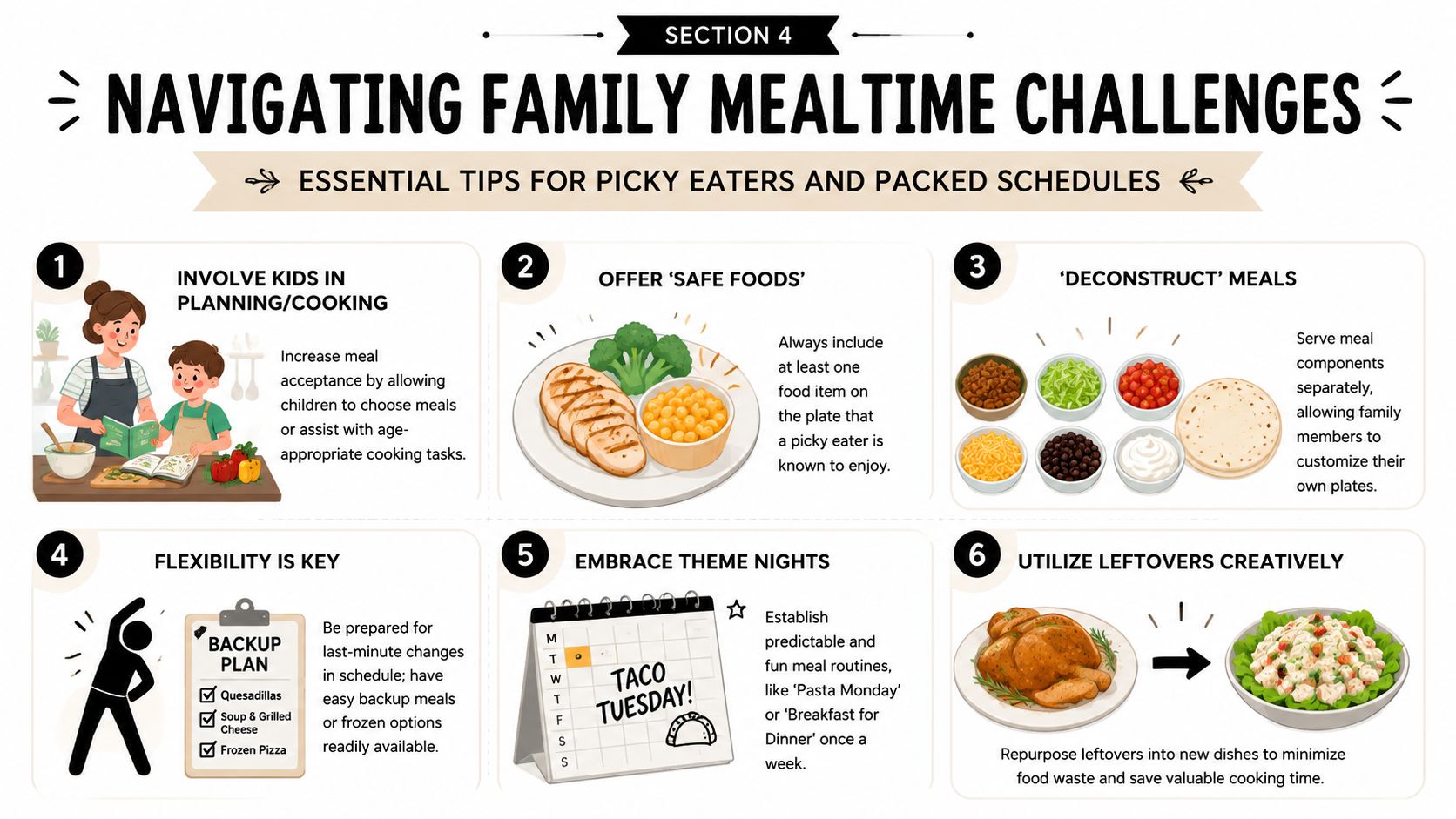
Lower resistance at the table
Picky eating gets worse when every dinner feels high stakes. Lower the pressure and make the structure more predictable.
A few tactics work well together:
- Serve deconstructed versions of meals. Taco bowls, baked potato bars, grain bowls, and pasta with separate toppings let each person build a plate they can handle.
- Include one safe food. That might be rice, fruit, bread, plain pasta, or a familiar vegetable.
- Let kids help choose from pre-approved options. Choice helps, but unlimited choice creates drama.
- Repeat meals without apology. Familiar food is often a feature, not a flaw.
If your family also has allergies, intolerances, or other food boundaries, this guide on how to plan meals for dietary restrictions offers a practical way to build flexible base meals.
Build backup into the plan
Families get in trouble when every dinner requires perfect execution. A resilient plan always includes a safety layer.
Keep these backups ready:
- A planned leftover night from a meal you intentionally doubled
- A fast pantry dinner such as quesadillas, soup and toast, or pasta
- A freezer option for nights that collapse unexpectedly
- A no-guilt takeout slot when the week is too full
“Cook once, eat twice” is more than a slogan. Roast extra chicken and turn it into wraps. Make more rice than you need and use it again. Double a sauce when you’re already cooking and freeze half.
A backup meal isn’t cheating. It’s part of the plan.
Theme nights help here too. They create predictability for picky eaters and reduce planning stress for adults. Packed schedules become easier to manage when the structure is already familiar.
Frequently Asked Meal Planning Questions
What if our schedule changes constantly
Don’t plan every night. Plan the nights most likely to fail without support.
For families with unpredictable weeks, the most useful system is often a partial plan. Choose a few anchor dinners, keep one leftover night, and stock two emergency meals that don’t require fresh ingredients. The plan should flex with the calendar, not fight it.
How do I handle different dietary needs in one family
Build meals from a shared base and vary the add-ons. Rice bowls, pasta bars, baked potato nights, tacos, and sheet-pan meals adapt well because each person can customize part of the plate.
Keep notes in your recipe library for swaps that already work. That’s faster than re-solving the same restriction every week. For toddler-specific inspiration when food acceptance is the main hurdle, this roundup of meal ideas for picky toddlers can give you a few low-pressure options to plug into your rotation.
Do I need to plan breakfast and lunch too
Usually not at first. Dinner carries the most pressure because it involves the whole household, timing, and cooking effort.
Once dinner feels stable, you can add a short breakfast and lunch rotation if it helps. Many families do well with repeat breakfasts, packed-lunch templates, and a stronger focus on dinner planning. Start where the stress is highest.
If your recipes still live in screenshots, bookmarks, and paper scraps, it’s hard to make meal planning stick. OrganizEat gives those recipes one searchable home so you can save ideas from social media, digitize handwritten cards, build grocery lists, and turn a scattered collection into a repeatable family system.