



You eat a normal Tuesday. Coffee on the way out, a rushed lunch, a few bites while cooking dinner, then you try to remember it all later. That is usually when details disappear. A printable food journal template works well because it stays in sight and makes logging fast enough to do in real time.
Paper also changes the quality of the record. You can jot down meals, drinks, symptoms, hunger, or energy without opening an app, getting pulled into notifications, or relying on memory. In practice, the best template is not the one with the most boxes. It is the one you will fill out for a full week.
Use the template that matches your purpose. Some are better for clinical tracking, where symptom notes and timing matter. Others fit fitness goals, where meal consistency, portion awareness, and activity matter more. A few are better for mindful eating because they leave room to record hunger, mood, and patterns like stress snacking.
If you manage allergies, IBS triggers, diabetes meals, or other food rules, a paper journal works even better when paired with a digital system for planning repeats and substitutions. A practical setup is to log by hand during the day, then save successful meals in a digital library built for planning meals around dietary restrictions.
If your main goal is weight loss, pair the journal with this weight loss calculator tool. Then keep the process simple: print one format, use it daily, and review it at the end of the week for patterns you can act on.
Table of Contents
- 1. CDC My Food and Beverage Diary
- 2. NIH/NHLBI Daily Food & Activity Diary
- 3. UCSF Osher Center Food Journal
- 4. WebMD Printable Food & Fitness Journal
- 5. Vertex42 Food Diary Template
- 6. TemplateLab Food Diary Templates Collection
- 7. Foodzilla Free Food Diary Template for Nutritionists
- 8. Maple Planners Free Printable Daily Food Journal
- 9. Printsbery Weekly Food Diary Template
- 10. BuiltLean Food Journal Template & Log
- Top 10 Printable Food Journal Templates Comparison
- Your Next Step Toward Mindful Eating
1. CDC My Food and Beverage Diary
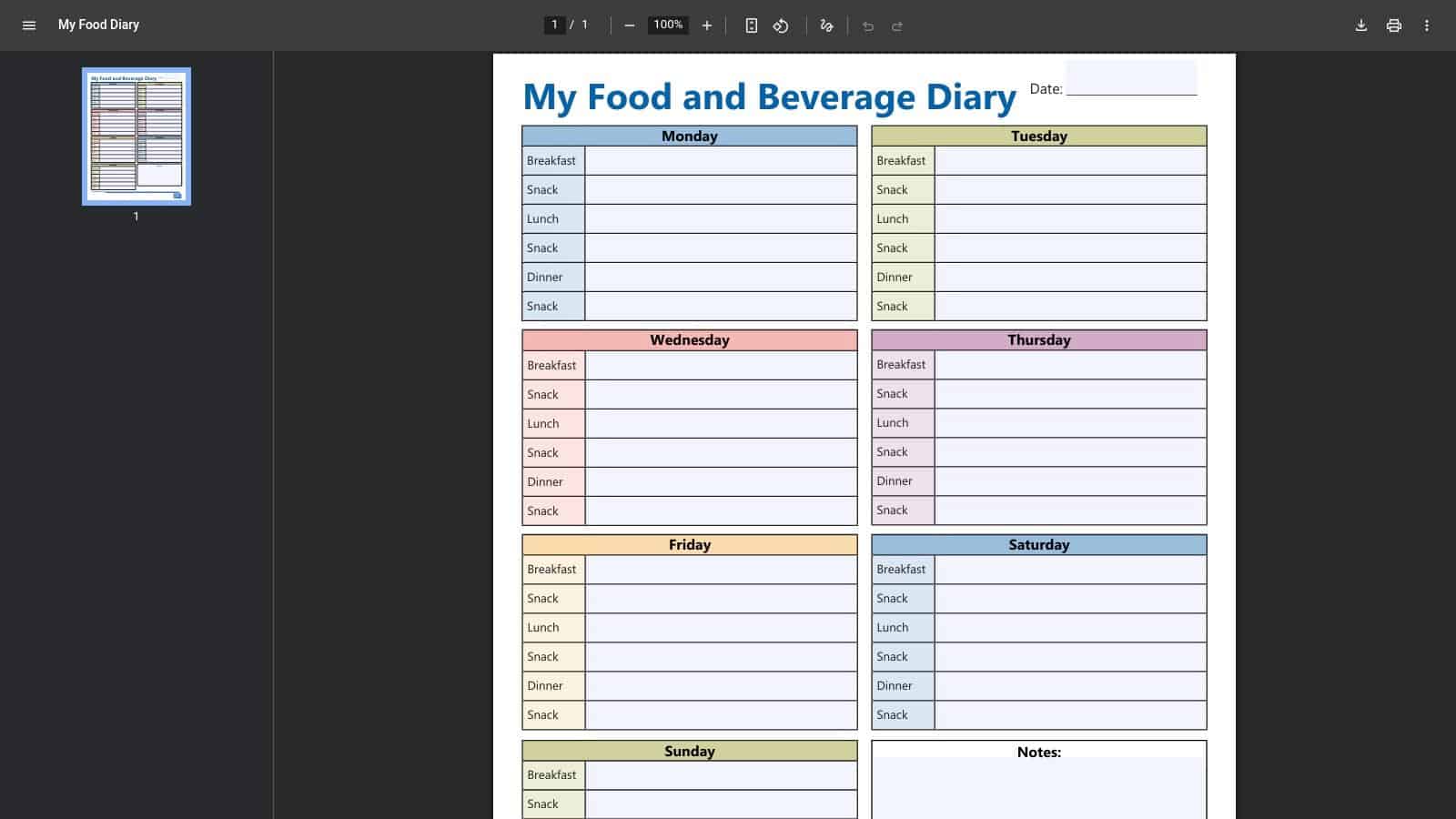
Monday starts well. By Thursday, details blur. If the goal is to spot what you ate over a full week, the CDC My Food and Beverage Diary keeps the job simple enough to finish.
This template works best for clinical tracking because it stays narrow. You record food and drinks, review the week, and move on. That restraint is useful. A lot of printable journals add mood prompts, hydration boxes, and habit trackers, but extra fields often create drop-off if someone only needs a clear intake record for a doctor, dietitian, or parent.
Best for clinical tracking
The main advantage is the weekly layout. One page shows patterns fast, including skipped breakfasts, repeated snacks, or the same late-night drink showing up several days in a row. If you're helping a child, an older parent, or anyone who needs low-friction tracking, that matters more than visual polish.
- Best use-case: Weekly intake review, family food tracking, basic clinician handouts
- What works: A full week is visible at once, so patterns stand out during review
- What doesn't: There's no built-in space for symptoms, mood, hunger levels, or hydration
I recommend this one for people who need consistency more than detail. If symptoms or food triggers matter, add a simple notation system in the margins. Circle problem meals, mark suspected triggers in all caps, and keep your repeat-safe meals in a separate digital system. That setup works well if you're also using a meal planning method for dietary restrictions.
For the paper-and-digital split, use the CDC sheet as the daily capture tool and OrganizEat as the storage system for recipes, approved meals, and grocery planning. Paper is faster in the moment. The app is better for reuse.
2. NIH/NHLBI Daily Food & Activity Diary
You eat reasonably well all day, take a short walk after dinner, and still end the week unsure why progress feels inconsistent. This diary helps because it puts food and activity in the same daily record, which makes behavior patterns easier to review.
The NIH/NHLBI Daily Food & Activity Diary fits best for people focused on fitness goals, weight management, or heart-health habits. The value is not fine-grained nutrition analysis. The value is seeing whether your meals, snacks, and movement choices line up across the day.
Best for fitness goals with behavior review
This template is plain, but the structure is useful.
- Best use-case: Weight-management efforts, exercise-aware food tracking, daily habit review
- What works: Meals and physical activity appear together, so it is easier to connect eating patterns with inactive stretches, workouts, or evening snacking
- What doesn't: It leaves little room for symptoms, mood, stress, or digestive notes
That trade-off matters. If your main question is, "Am I following the habits I planned?" this sheet does the job well. If your main question is, "Which foods trigger bloating, fatigue, or cravings?" you will outgrow it quickly.
I usually recommend this kind of diary for a short review window, then a weekly check-in. Print several copies, keep them somewhere visible, and use the same shorthand each day for portions, workout intensity, or missed meals. Consistency matters more than detail overload.
For a paper and digital setup, use this diary as the capture tool, then move repeat meals into OrganizEat. Save the breakfasts, lunches, and post-workout meals you stick with. That turns a handwritten log into a reusable meal system instead of a stack of pages you never revisit.
3. UCSF Osher Center Food Journal
The UCSF Osher Center Food Journal is the most flexible option here. It doesn't force every meal into a rigid calorie-first system, which makes it especially helpful if your real question is not “How much did I eat?” but “How did this meal affect me?”
That distinction matters. Many food journals focus on meals, portions, calories, macros, hunger, and mood, while only some include symptoms such as bloating or fatigue. That leaves a real gap for people trying to connect food with energy, sleep, stress, or digestive reactions, as noted in this discussion of what to track beyond calories.
Best for mindful eating and symptom patterns
If you're doing an elimination diet, dealing with GI issues, or trying to notice food-energy connections, this is a strong choice. The open format gives you room to capture context that stricter logs tend to miss.
Sometimes the most useful note on the page isn't the food itself. It's “ate fast, stressed, meeting in 10 minutes.”
The downside is obvious. If you want totals, summaries, or macro boxes, you won't get them here. This is a reflection-friendly journal, not a spreadsheet on paper.
For a hybrid system, log meals and symptoms by hand, then save safe recipes and weekly dinner plans in OrganizEat so you're not rebuilding your routine from scratch each week.
4. WebMD Printable Food & Fitness Journal
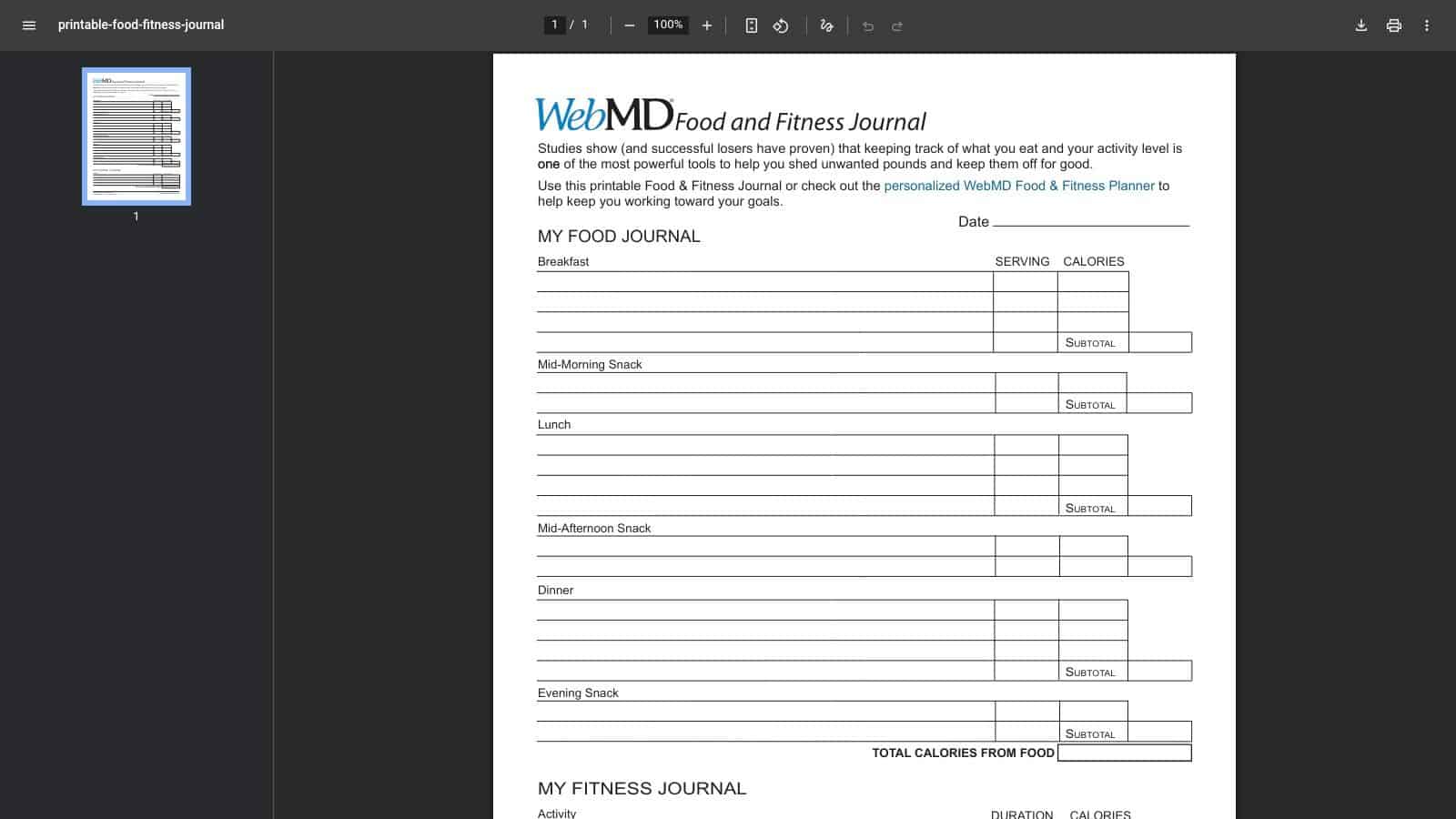
The WebMD Printable Food & Fitness Journal feels like an older health-magazine worksheet, and that's not necessarily a bad thing. It's compact, familiar, and easy to copy. If you're new to tracking, that kind of low-pressure format can be easier to stick with than a detailed planner page.
I'd put this in the beginner category. It gives you enough structure to record food and activity but not so much that you spend more time filling boxes than paying attention to what you ate.
Best for beginners who want a compact page
This template works well if you want a printable food journal template you can fold into a notebook, keep in a bag, or print in batches without burning through ink.
- Best use-case: First-time tracking, compact daily use, simple food-plus-fitness logging
- What works: Quick to understand and quick to reprint
- What doesn't: No built-in weekly summary, and the design feels dated
If your exercise routine is a meaningful part of your eating pattern, pair this with a practical exercise library like Exercises. Keep the journal focused on what you did and how you fueled it, not on trying to turn the page into a full training plan.
This is one of those templates that succeeds because it doesn't ask for too much. For many people, that's exactly why it lasts.
5. Vertex42 Food Diary Template
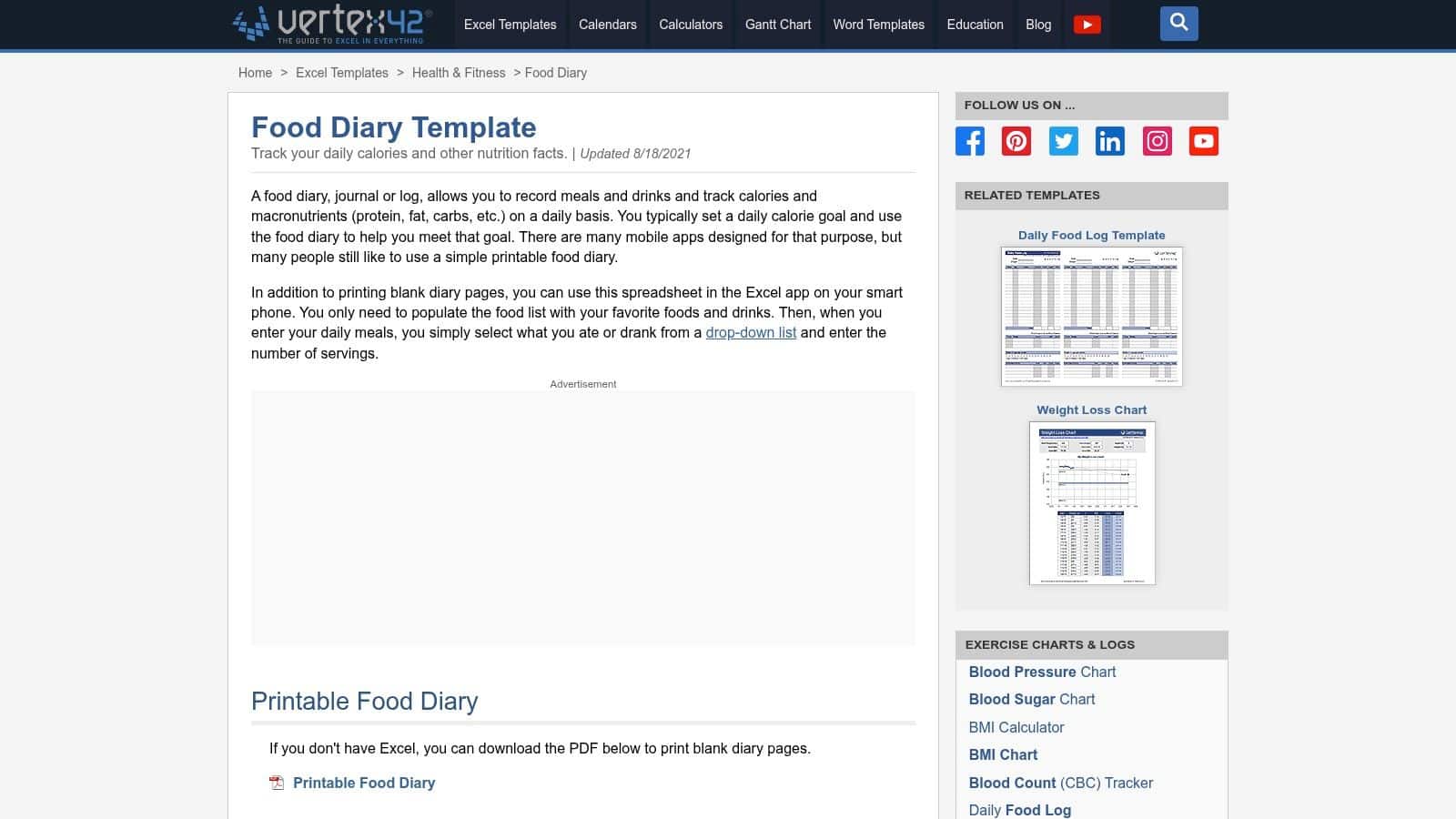
You print a food journal, use it for three days, and then realize one column is wrong for how you eat. That is the problem Vertex42 solves better than most printable options.
The Vertex42 Food Diary Template gives you a paper log and an editable spreadsheet version. That combination makes it a strong fit for people who want more control before they print a full stack. If you track meals for fitness goals, blood sugar patterns, or family meal routines, being able to adjust the structure first saves time and frustration.
Best for printable-plus-digital customization
This template works best for people who already know that a fixed PDF is too rigid. You can rename columns, add rows for water or symptoms, and keep separate versions for weekdays, training days, or household meal planning.
- Best use-case: Spreadsheet users, customized tracking, hybrid paper-and-digital systems
- What works: Easy to edit before printing, practical for repeat use, flexible enough for different goals
- What doesn't: You need to set up your own calculations if you want nutrition totals or macro tracking
That trade-off matters. More flexibility gives you a better fit, but it also asks you to make decisions. A highly structured clinical tracker is faster to start. Vertex42 is better when your needs are specific enough that small layout changes will help you stay consistent.
As noted earlier, meal-by-meal logging usually works best when the page matches the behavior you are trying to notice. Vertex42 handles that well because you can build a version for clinical tracking, a simpler one for mindful eating, or a training-focused sheet with space for pre- and post-workout meals.
For OrganizEat users, this is one of the easier templates to integrate into a mixed system. Keep recipes, grocery planning, and saved meal ideas digital, then print a diary built around those patterns. If you are still deciding how much should stay on paper versus in an app, this guide to paper vs digital recipe storage methods will help you choose a setup you will maintain.
6. TemplateLab Food Diary Templates Collection
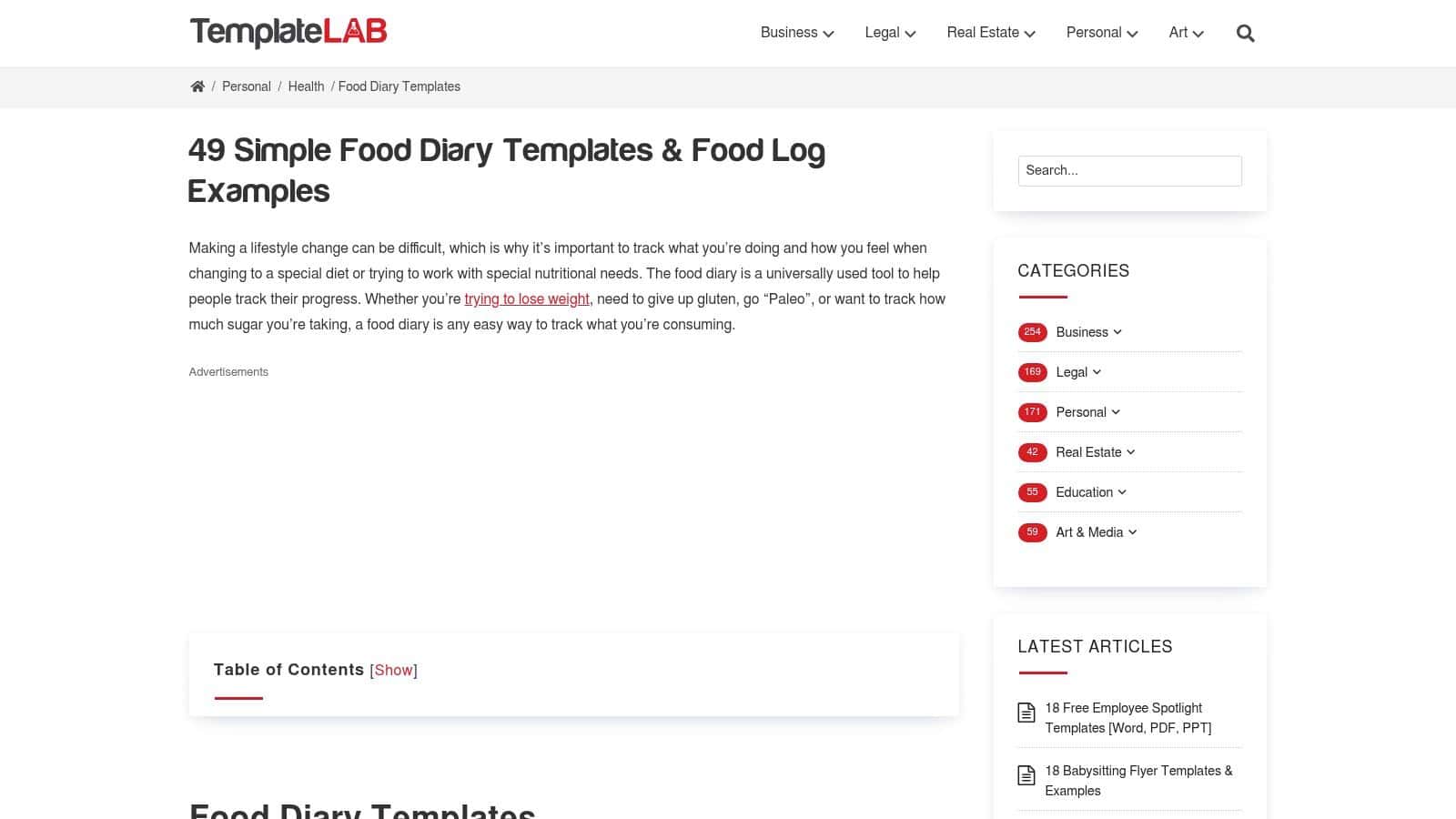
The TemplateLab food diary collection is the best option if you don't yet know what style will work for you. Instead of one fixed printable food journal template, you get a gallery of formats. That's useful because people often choose the wrong template first. They download a strict calorie log when they really needed a food-and-mood page, or they pick a daily page when a weekly overview would've been easier to maintain.
The upside here is variety. The downside is that you have to curate it yourself.
Best for testing different journaling styles
If you're in discovery mode, this collection gives you room to experiment before committing.
- Best use-case: Trying daily versus weekly layouts, testing symptom or mood tracking, households with different needs
- What works: Broad range of formats and file types
- What doesn't: Quality varies, and the site requires a bit of patience
One useful approach: Print two or three different styles for the same week, then keep the one you actually finished.
This is also a good place to decide whether you're better with paper, digital, or both. If you're weighing that trade-off for recipes as well as meal notes, this comparison of paper versus digital recipe organization helps clarify where each format fits.
TemplateLab is less a single recommendation than a test bench. That's why it earns a place on the list.
7. Foodzilla Free Food Diary Template for Nutritionists
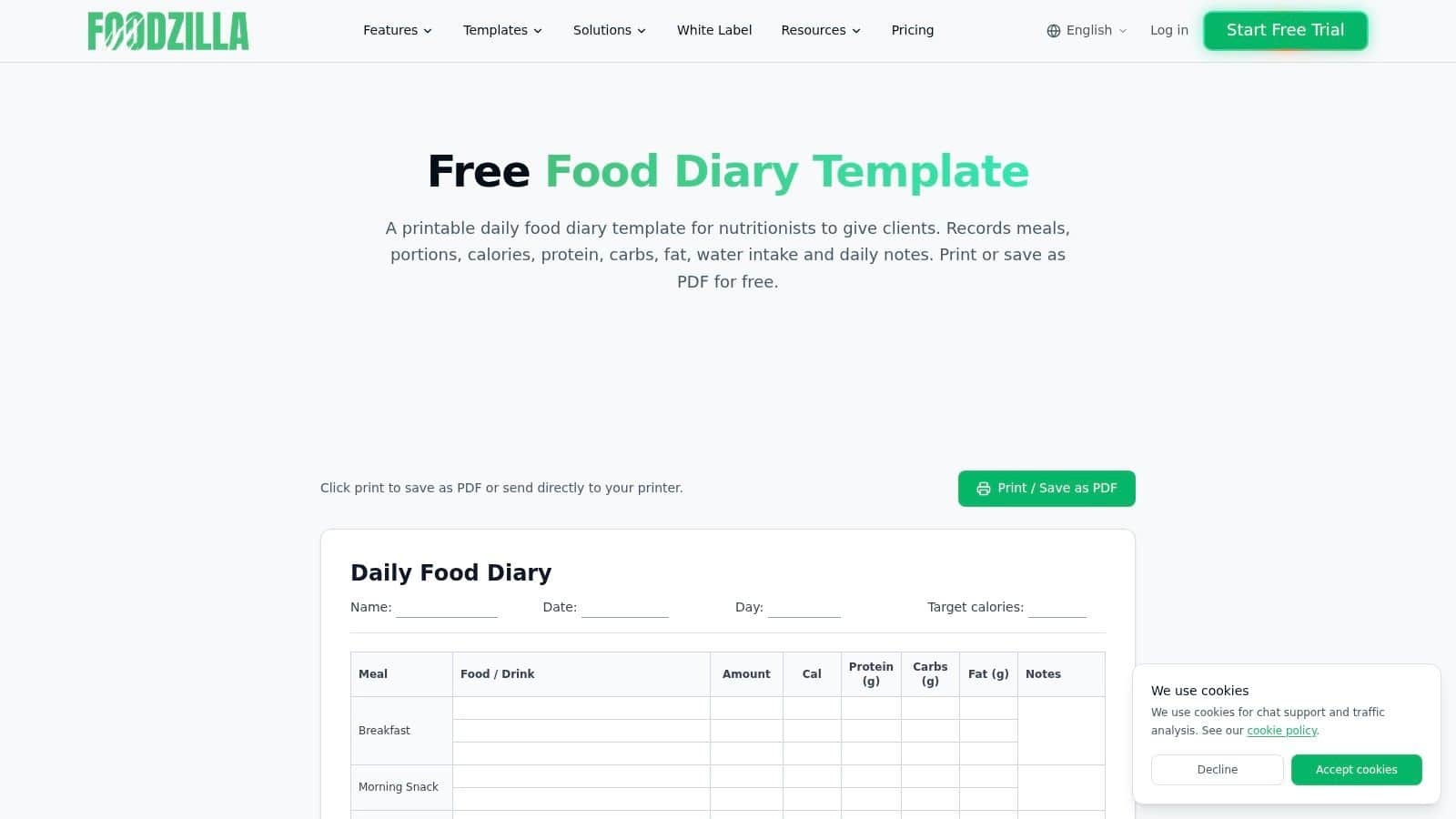
A common problem in nutrition coaching is simple: the client brings back a food log, but the format makes it harder to review than the eating pattern itself. Foodzilla avoids that problem. The Foodzilla food diary template is laid out for quick practitioner review, with clear spaces for time, foods, and amounts.
Best for clinical tracking and practitioner check-ins
This is the most clinician-friendly printable food journal template in this part of the list. It works well for dietitians, nutritionists, health coaches, and clients who need to hand over a log that can be scanned fast during an appointment.
- Best use-case: Clinical tracking, nutrition counseling, portion review, follow-up visits
- What works: Clean structure, easy to review, good fit for identifying timing and intake patterns
- What doesn't: Very limited space for mood, hunger, hydration, symptoms, or triggers
That trade-off matters. If the goal is accountability and accurate recall, a stripped-down page often works better than a reflective one. If the goal is mindful eating or symptom correlation, this template can feel too narrow unless you add notes by hand in the margins.
I'd use this one when the journal needs to support a conversation with a professional, not just private self-reflection.
It also pairs well with a hybrid paper-and-digital setup. Keep recipes, grocery planning, and recurring meals inside OrganizEat, then use the printed page to record what was eaten and when. That planned-versus-actual gap is often where the useful insight shows up, especially in homes already trying to build a steadier routine with meal planning for busy families.
Foodzilla earns its place here because it serves a specific job well. It is not the warmest or most flexible printable food journal template on the list, but for professional review, that restraint is a strength.
8. Maple Planners Free Printable Daily Food Journal
The Maple Planners daily food journal is the most kitchen-counter-friendly option on this list. It looks approachable, it's easy to read, and it has the kind of daily layout many busy households will use. That matters if more than one person in the home might glance at it or add to it.
This one is especially practical for family routines. Breakfast, lunch, dinner, snacks, water, and notes are the right level of detail for home use.
Best for family routines and daily visibility
Some templates are technically solid but feel too clinical. Maple Planners is the opposite. It's welcoming without becoming fluffy.
- Best use-case: Families, home meal routines, hydration awareness
- What works: Fast to start, easy to leave out in plain sight
- What doesn't: No weekly roll-up and no calorie or macro summary boxes
A visible page often beats a perfect page hidden in a drawer.
This template pairs well with practical meal planning. If your biggest problem is not logging but figuring out dinner before everyone gets hungry, this guide to meal planning for busy families fits naturally with the journal.
The best setup here is simple: use OrganizEat to plan meals and save recipes, then use the printed page to record what the family ate. Planned and actual meals are often not the same, and seeing that gap is useful.
9. Printsbery Weekly Food Diary Template
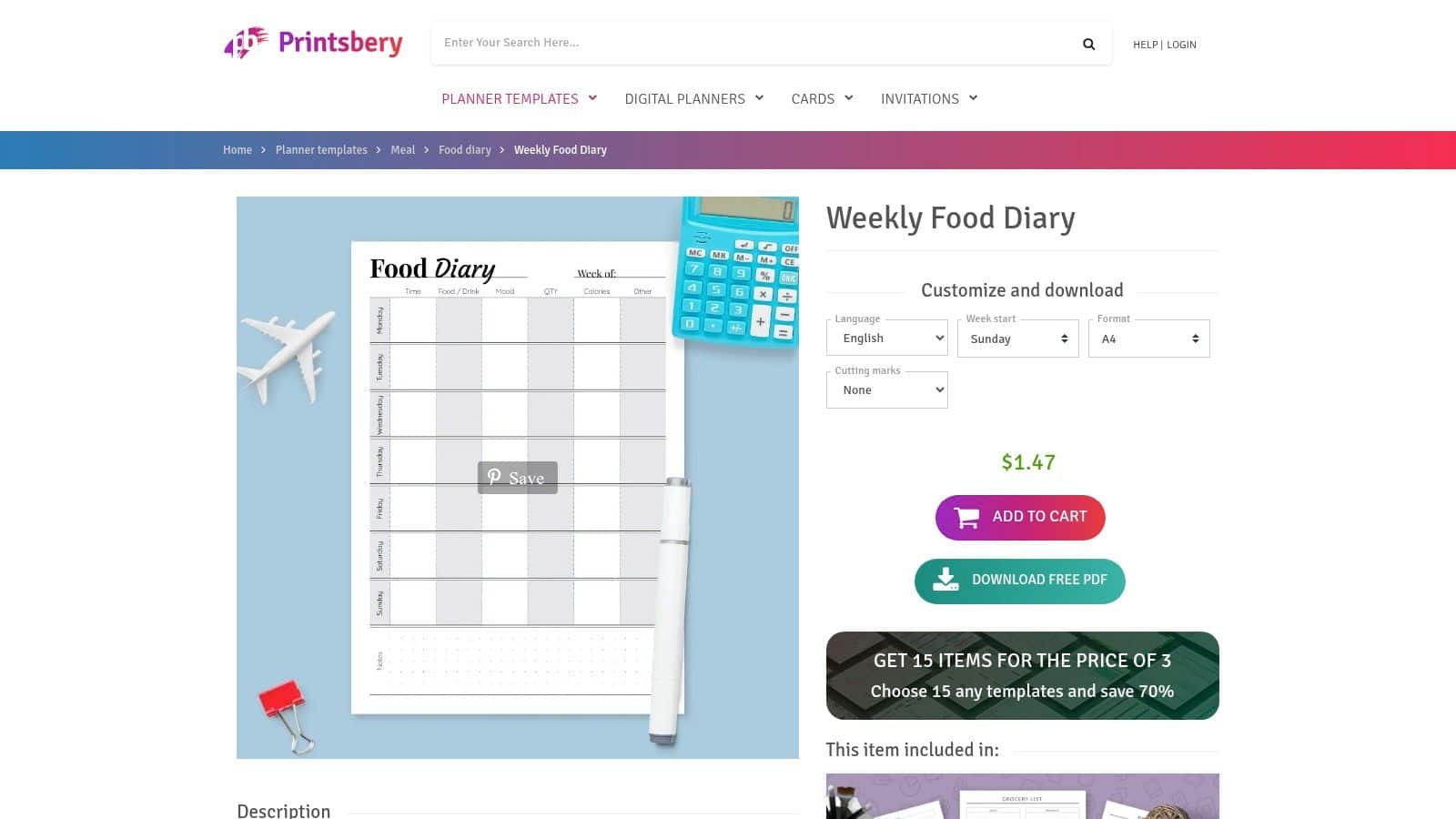
Sunday night is often when good intentions are still intact and the coming week looks manageable. A weekly sheet earns its place right there. The Printsbery weekly food diary works best for people who want to review the whole week at a glance instead of managing a separate page every day.
Its biggest strength is pattern spotting. A weekly format makes it easier to catch skipped breakfasts, repetitive lunches, late-night snacking, or the usual drop-off that happens once the weekend starts. That broader view is useful for mindful eating and for routine cleanup. It is less useful for clinical tracking, where portion details, symptoms, or medication timing often need more room.
Best for weekly review and planner users
Printsbery fits planner users, visual organizers, and anyone who will keep a journal only if it looks tidy enough to stay in use. The trade-off is simple. You get better week-to-week visibility, but you give up depth on each meal line.
That makes this a strong choice for behavior review, not detailed nutrition analysis.
If you use OrganizEat, keep the digital side focused on planning and repetition. Save your standard breakfasts, packable lunches, and dinner rotation in the app. Then use the printed weekly page to mark what really happened. That split works well in practice because planned meals and eaten meals rarely match perfectly, and the gap is often where the useful insight is.
For readers comparing use-cases across this list, Printsbery belongs in the mindful-eating and weekly-routine category. It is less suited to symptom tracking than the more clinical templates, and less suited to macro-focused training logs than the fitness-oriented options.
10. BuiltLean Food Journal Template & Log
A common problem shows up a few weeks into a training block. Meals start drifting, recovery feels uneven, and the app log is too polished to show what happened. The BuiltLean food journal PDF works well for that gap because it supports performance-focused tracking without turning every meal into a spreadsheet exercise.
BuiltLean sits in the middle of this list. It is more fitness-oriented than a general mindful-eating worksheet, but less rigid than a clinical or macro-heavy log. That balance makes it useful for readers who care about meal quality, consistency, and training support, yet know they will quit if the template asks for too much detail on every line.
Best for fitness goals with some reflection built in
The layout is clean, current, and quick to scan. That matters on busy weekdays, especially for people logging around work, training, and meal prep. It also leaves space to note how the day went, which is often the difference between a food log you fill out and one you learn from.
- Best use-case: Strength phases, fat-loss phases, and performance-focused eating
- What works: Good balance between structure and usability. Strong fit for paper tracking during short training cycles
- What doesn't: It can feel repetitive for long-term daily use, and any totals or comparisons still have to be done by hand
In practice, this template is strongest as a short-run accountability tool. I would use it for a defined period, such as a cut, a muscle-gain phase, or a reset after travel, not as a forever journal. Daily paper logs create awareness fast, but they also create friction. That trade-off is worth it for focused goals and less appealing for casual logging.
The paper-plus-digital setup is straightforward. Keep recurring meals, grocery planning, and saved recipes in OrganizEat. Use the printed BuiltLean page to capture what changed that day, especially restaurant meals, snack drift, workout-day hunger, or missed recovery meals. That split gives you a cleaner planning system on the digital side and a more honest record on the page.
For use-case comparison, BuiltLean belongs in the fitness-goals category first. It can still support mindful eating because of the reflection space, but it is not the best choice for clinical symptom tracking, medication timing, or elimination-diet detail.
Top 10 Printable Food Journal Templates Comparison
| Template | Core features | 👥 Target | ✨ Unique | ★ Quality | 💰 Price |
|---|---|---|---|---|---|
| CDC, My Food and Beverage Diary | 7-day printable, meals/snacks, notes, B/W low-ink | Clinicians & families 👥 | ✨ Clinician-friendly, low‑ink design | ★★★★ | 💰 Free |
| NIH/NHLBI, Daily Food & Activity Diary | Food + activity on one page, behavior-change focus | Weight/heart-health users & clinicians 👥 | ✨ Combined food+activity layout for weekly review | ★★★★ | 💰 Free |
| UCSF Osher Center, Food Journal | Open-format one-page, time/food/context fields | Symptom trackers & elimination diets 👥 | ✨ Mindful, qualitative notes for reactions | ★★★★ | 💰 Free |
| WebMD, Printable Food & Fitness Journal | Compact printable, food + fitness fields, notes | Beginners & casual journalers 👥 | ✨ Ink-efficient, recognizable brand template | ★★★ | 💰 Free |
| Vertex42, Food Diary Template | Weekly Excel + PDF, tracks food & water, editable | Spreadsheet users who print 👥 | ✨ Editable in Excel/Sheets then printable | ★★★★ | 💰 Free |
| TemplateLab, Food Diary Templates collection | Multiple layouts (daily/3/7-day), PDF/Word/Excel | Users wanting variety & experimentation 👥 | ✨ Large gallery with mood/symptom variants | ★★★ | 💰 Free (varies) |
| Foodzilla, Free Food Diary for Nutritionists | One-day-per-sheet, time/food/amount columns | Dietitians & nutrition pros 👥 | ✨ Clinician-ready, client-friendly PDF | ★★★★ | 💰 Free |
| Maple Planners, Free Printable Daily Food Journal | Daily meals, snacks, hydration tracker, notes | Busy families & home users 👥 | ✨ Dedicated water tracker, attractive layout | ★★★★ | 💰 Free |
| Printsbery, Weekly Food Diary Template | One-week overview, multiple paper sizes, planner aesthetic | Planner users & design-conscious 👥 | ✨ Planner-friendly sizes (A4/A5/US) | ★★★★ | 💰 Paid/varies |
| BuiltLean, Food Journal Template & Log | Daily intake + reflection, fitness focus | Fitness enthusiasts & trainees 👥 | ✨ Reflection prompts for training programs | ★★★★ | 💰 Free |
Your Next Step Toward Mindful Eating
The best printable food journal template isn’t the one with the most boxes. It’s the one you’ll keep using after the first burst of motivation wears off. That’s why the list above covers different kinds of users instead of pretending one page works for everyone.
If you want something clinician-friendly and easy to review, CDC and Foodzilla are strong picks. If you care about pairing meals with movement, NIH/NHLBI and WebMD make more sense. If your goal is awareness, symptoms, or mindful eating, UCSF Osher gives you more room to think. And if design matters because it affects whether you’ll print and use the thing, Maple Planners and Printsbery are better fits.
The biggest mistake people make is choosing a template that asks for too much detail too soon. A page with calories, macros, water, mood, symptoms, meal timing, and reflections can look impressive, but it often becomes homework. If you’ve never tracked before, start with fewer fields. Build the habit first. Add complexity later if you need it.
Paper also works best when it has a clear role. Use it for fast capture and visible awareness. Use digital tools for storage, planning, and repeatability. That’s where pairing a printed journal with OrganizEat makes practical sense. Write down what you ate, how you felt, and what changed during the week. Then keep your recipes, meal ideas, and grocery plans in one organized digital place so you’re not reinventing dinner every few days.
Another useful rule is to pick a time horizon before you print. Daily pages are better when you need detail, symptom notes, or accountability after each meal. Weekly pages are better when you want a lighter system and a broader view. Neither is automatically better. They solve different problems.
If you’re not sure where to start, choose one template and commit to one week. That’s enough time to learn whether the layout fits your life. Don’t aim for perfect handwriting, perfect portions, or perfect consistency. Aim for an honest record. The page is there to reveal patterns, not to grade your behavior.
Individuals often don’t need a dramatic nutrition reset. They need a simple way to notice what’s already happening. A printable journal does that surprisingly well. Pick the one that matches your goal, print it, and let the first week teach you what to change next.
If you want your printable journal to work better, pair it with a recipe system that removes day-to-day friction. OrganizEat lets you save recipes from social media and websites, digitize handwritten cards, build shopping lists, and plan meals on a calendar across phone, tablet, and web. Use the printed journal for awareness. Use OrganizEat to keep the meals, recipes, and grocery planning organized enough to stick.