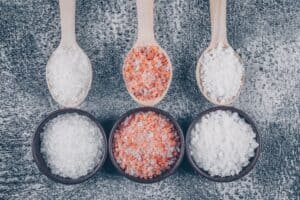



You're in the grocery aisle or halfway through a recipe video, and the salt callout suddenly matters. The pasta recipe says coarse sea salt. The cookie recipe wants flaky sea salt. Your pantry has a grinder of pink Himalayan salt, a canister of table salt, and maybe a box of coarse salt you bought for one holiday roast and forgot about.
That's where the sea salt vs rock salt question gets confusing for a lot of home cooks. The packaging makes each one sound like it has a special purpose, and health claims often muddy the water even more. What matters in the kitchen is much simpler. You need to know where the salt comes from, how the crystals behave, and when texture changes the result on the plate.
If you cook often, this isn't a small detail. Salt affects seasoning, browning, crunch, dissolving, and how repeatable your recipes are. A dish can taste flat or harsh just because the crystals were the wrong size for the job.
Table of Contents
- The Great Salt Debate in Your Kitchen
- Origin and Production From Ocean to Mountain
- A Deeper Look at Minerals Texture and Sodium
- The Flavor Profile Does Salt Taste Different
- The Ultimate Culinary Guide Best Uses for Each Salt
- Storing Your Salt and Cost Considerations
- Common Salt Questions for Home Cooks
The Great Salt Debate in Your Kitchen
A lot of salt confusion starts with a very ordinary moment. Dinner is already in motion, the onions are softening, and you glance at your phone to check the next step. The recipe says “finish with flaky sea salt.” You don't have flaky sea salt. You have pink salt in a mill and a box of regular salt in the pantry. Is that close enough, or are you about to ruin the dish?
That question comes up because the salt aisle now looks like a specialty shop. Fine sea salt, coarse sea salt, kosher-style salt, Himalayan pink salt, grey salt, smoked salt, rock salt, table salt. Some are meant for baking, some for finishing, some for grinders, and some are there mostly because the jar looks good next to olive oil.
The problem is that most advice stops at broad labels. Sea salt gets framed as premium and healthier. Rock salt gets treated like a rough utility ingredient. In real cooking, those labels don't help much. What helps is knowing how the crystals dissolve, how strongly they season by spoonful, and whether they add crunch or disappear cleanly.
Practical rule: If a recipe's salt choice affects texture, appearance, or how fast it dissolves, the specific type matters. If it's going into a long-cooked soup or stew, the label matters less than the crystal size.
Home cooks don't need a chemistry lecture every time they season a pan of vegetables. They need a reliable way to decide what to grab. That's the useful part of the sea salt vs rock salt conversation. It's less about prestige and more about function.
Origin and Production From Ocean to Mountain
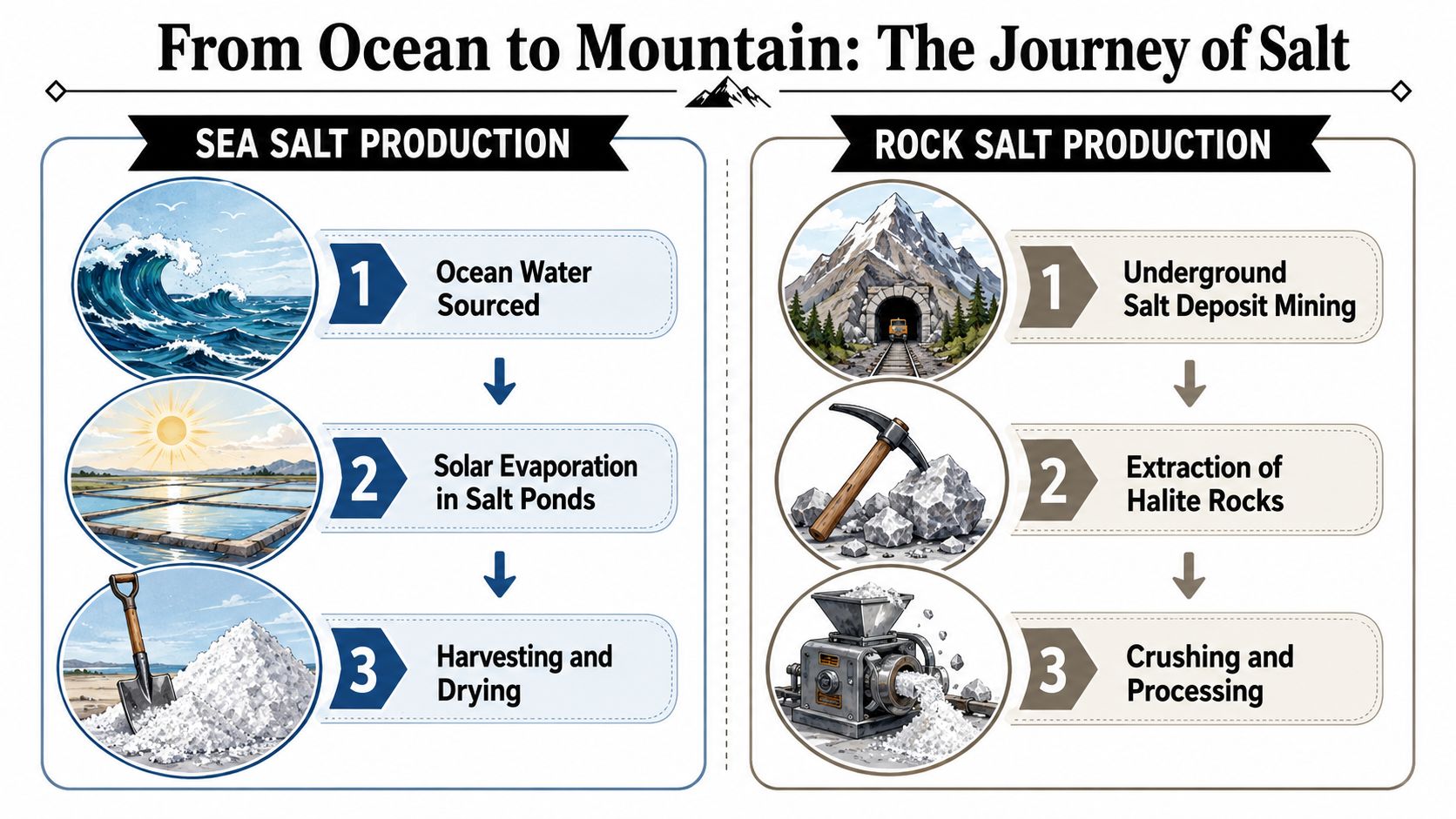
The easiest way to remember the difference is this. Sea salt starts as water. Rock salt starts as stone. That basic distinction shapes everything that follows, from crystal form to handling in the kitchen.
How sea salt is made
Sea salt is produced by evaporating seawater through exposure to wind and sun. That means producers collect seawater, guide it into shallow ponds or basins, and allow the water to disappear naturally until salt crystals remain. This fundamental difference is described clearly in Holland & Barrett's overview of rock salt and sea salt.
That process helps explain why sea salt can show up in several textures. Depending on how it's harvested and dried, it may be fine, flaky, damp, coarse, or softly clumped. Some sea salts are delicate enough to crush between your fingers over a tomato salad. Others are better for general seasoning.
Sea salt often feels more artisanal because harvesting can be gentler and more selective. In practical terms, that means a home cook may notice prettier flakes, softer crunch, or a more interesting finish on food.
How rock salt gets to your kitchen
Rock salt comes from underground deposits in solid form. Miners extract it from ancient salt beds, then crush or process it into the sizes sold for cooking, grinding, curing, or other uses.
That route gives rock salt a different physical personality. It's usually harder, denser, and more angular. If sea salt can feel airy or brittle, rock salt often feels compact and sturdy. That's why some rock salts work especially well in grinders and why very coarse versions are useful for tasks where you want a larger crystal that won't vanish instantly.
Sea salt is gathered after water leaves. Rock salt is gathered by breaking apart a deposit that's already solid. If you remember that, the rest of their differences make more sense.
For a cook, origin matters because it predicts behavior. Salt that forms through evaporation can produce flakes and fragile crystals. Salt that comes out of the ground as a mineral deposit often arrives with a more rigid structure. You don't need to memorize geology. You just need that mental picture when a recipe asks for one and your pantry offers another.
A Deeper Look at Minerals Texture and Sodium
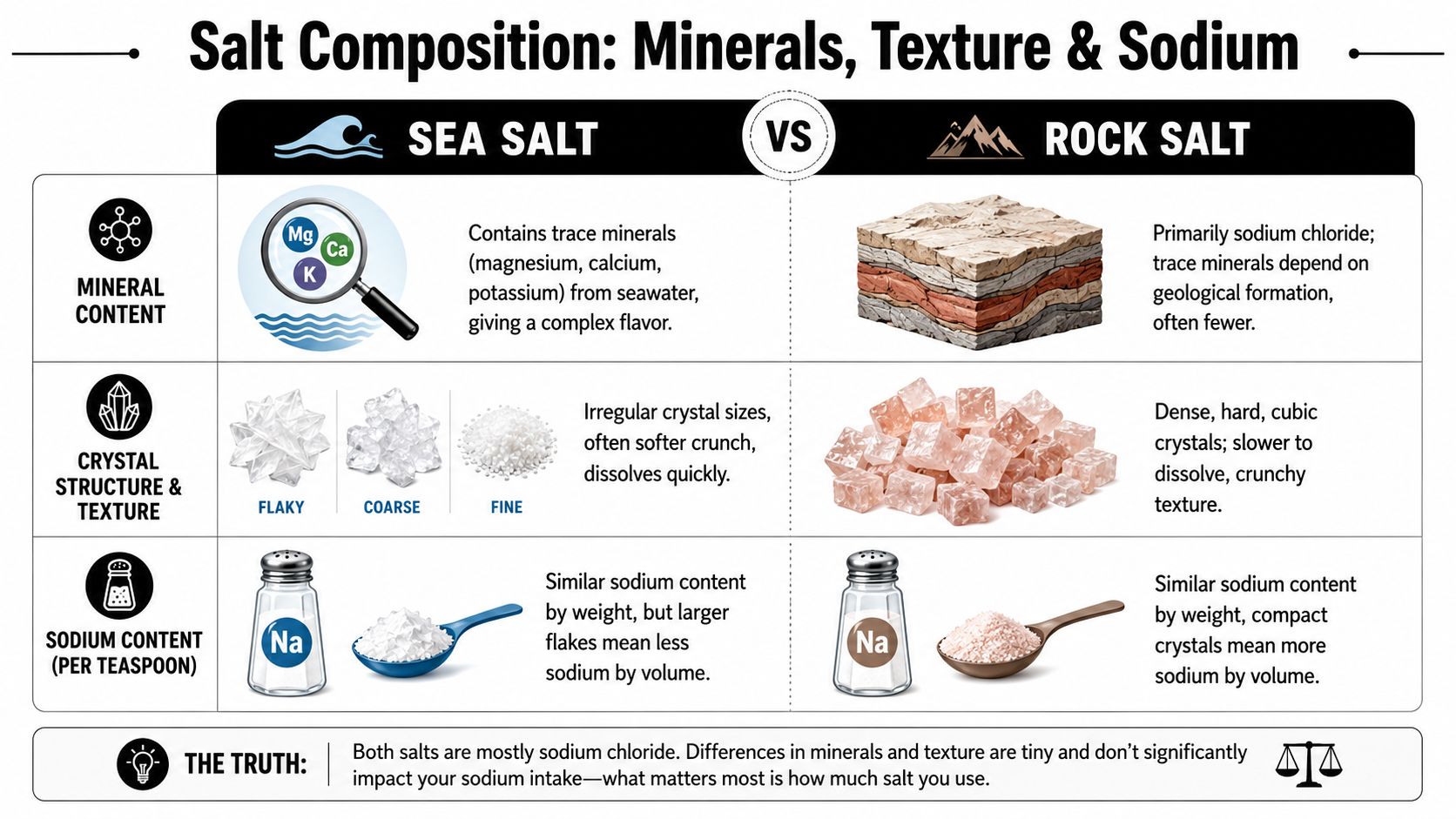
Health claims dominate most discussions about sea salt vs rock salt, but they rarely answer the question a cook has. Will this salt change the dish in a meaningful way? Usually, the answer has less to do with trace minerals and more to do with how the crystals sit in a spoon, on a steak, or on your tongue.
Sea Salt vs. Rock Salt at a Glance
| Attribute | Sea Salt | Rock Salt (including Himalayan) |
|---|---|---|
| Source | Made by evaporating seawater | Mined from underground salt deposits |
| Common textures | Fine, flaky, coarse, sometimes slightly moist | Coarse, dense, hard, irregular or chunky |
| Mineral story | May contain trace minerals from source water | Trace minerals also vary by source |
| Sodium role | Primarily sodium chloride | Primarily sodium chloride |
| Best kitchen advantage | Finishing texture and delicate crunch | Grinding, brining, robust seasoning tasks |
| Main caution | Flakes and coarse crystals can measure inconsistently by volume | Large crystals can under-salt if swapped spoon-for-spoon |
A broader overview of kitchen salt categories can also help if you're sorting pantry staples. This guide to different types of salt is useful for seeing where sea salt, rock salt, and other common options fit.
The mineral myth in plain English
A 2023 study on gourmet salts found that mineral content varies by source, not solely by whether a salt is from the sea or from rock. In that study, some sea salts had the highest concentrations of certain minerals, while some rock-derived salts had the highest levels of others. That matters because it undercuts the simple story that sea salt is automatically richer or more beneficial.
The same study also found that health-relevant minerals such as potassium are present in amounts so low that they don't make a significant contribution to blood pressure or heart health compared with rock or table salt. So if you've been told to buy sea salt for mineral nutrition, that's not the kitchen advantage worth paying for.
This is also why specialty salts often make more sense as sensory ingredients than wellness ingredients. If you enjoy using salts in bathing rituals as well as cooking, guides like Japanese bath salt for ultimate relaxation can be a nice separate read, but that's a different conversation from what a salt does in dinner.
Why crystal shape matters more than marketing
The practical issue is density by volume. Large or irregular crystals leave more empty space in a spoon than fine crystals do. So two salts can be very similar by weight and still season very differently if you measure with teaspoons or tablespoons.
That's why one cook says a dish came out bland after switching salts, while another says the same swap made no difference. If both weighed the salt, results would be closer. If both eyeballed it by spoonful, results could drift fast.
Here's what usually works best:
- For repeatable cooking: Weigh salt when a recipe is sensitive, especially in baking, doughs, or curing.
- For casual stovetop dishes: Adjust by taste, but pay attention to crystal size before swapping.
- For finishing: Choose the texture you want people to feel, not a label that promises health.
The Flavor Profile Does Salt Taste Different
Salt can taste different, but not always in the way people expect. The difference usually isn't that one salt is magically more savory than another. It's that the crystal changes how quickly salinity hits your mouth and how evenly it spreads across the food.
Texture changes flavor perception
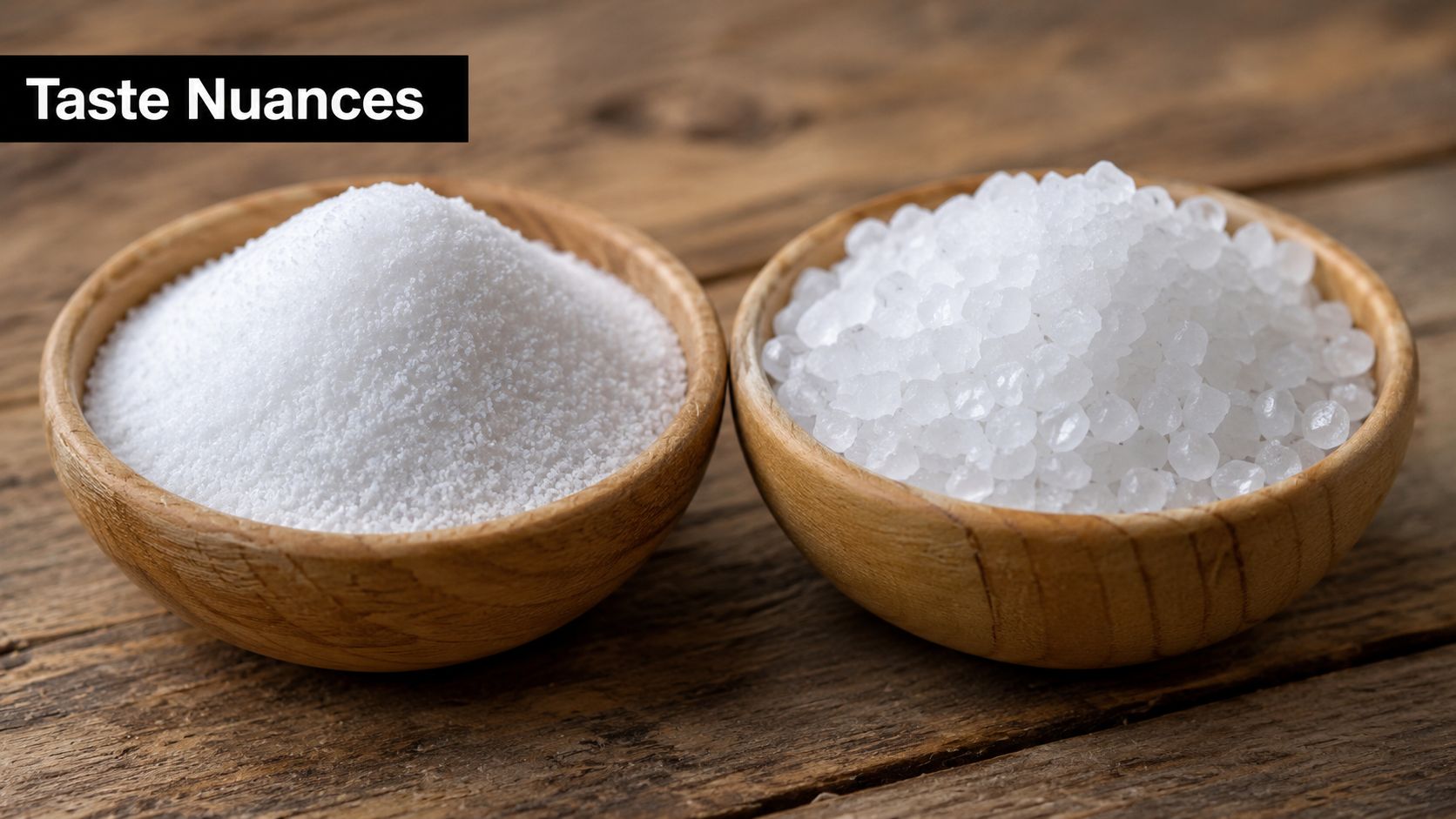
A sea salt flake can land lightly on the surface of a roast potato or chocolate cookie, then dissolve quickly when you bite it. That gives a clean pop of salt and a little crunch without staying hard. A dense crystal of rock salt can feel more forceful and more localized. You notice it where it lands.
Sea salt may also carry trace minerals such as magnesium, sulfate, potassium, and calcium that can alter flavor and texture, as noted in this discussion of sea salt composition and effects. But the same source notes that the potassium level is too low to provide clinically beneficial effects on blood pressure when sea salt is used as a substitute. In the kitchen, that means flavor nuance is the more realistic reason to choose it.
A finishing salt isn't just seasoning. It's part of the texture of the last bite.
This is why flaky sea salt feels so different on focaccia, caramel, sliced tomatoes, or a fried egg. You're tasting the salt, but you're also feeling how it breaks. That tactile part changes the whole impression.
When the difference is worth caring about
If salt dissolves completely into a soup, braise, or tomato sauce, the taste gap narrows. Once fully dispersed, the dish mostly registers overall salinity. In those cases, the shape of the crystal matters mainly for how quickly it dissolves and how easy it is to measure.
Where the difference becomes obvious is on the surface of food:
- Roasted vegetables benefit from salts that cling without becoming pebbly.
- Steaks and chops handle bolder crystals well when you want a stronger burst.
- Cookies and caramels almost always benefit from flakes rather than hard chunks.
People often say one salt tastes “softer” or “sharper.” That's usually a texture-and-dissolution story, not proof that one type is nutritionally superior.
The Ultimate Culinary Guide Best Uses for Each Salt
If you cook at home a lot, the best approach is to stop looking for one perfect salt. Keep a small lineup and give each one a job.
Use sea salt when texture is part of the dish
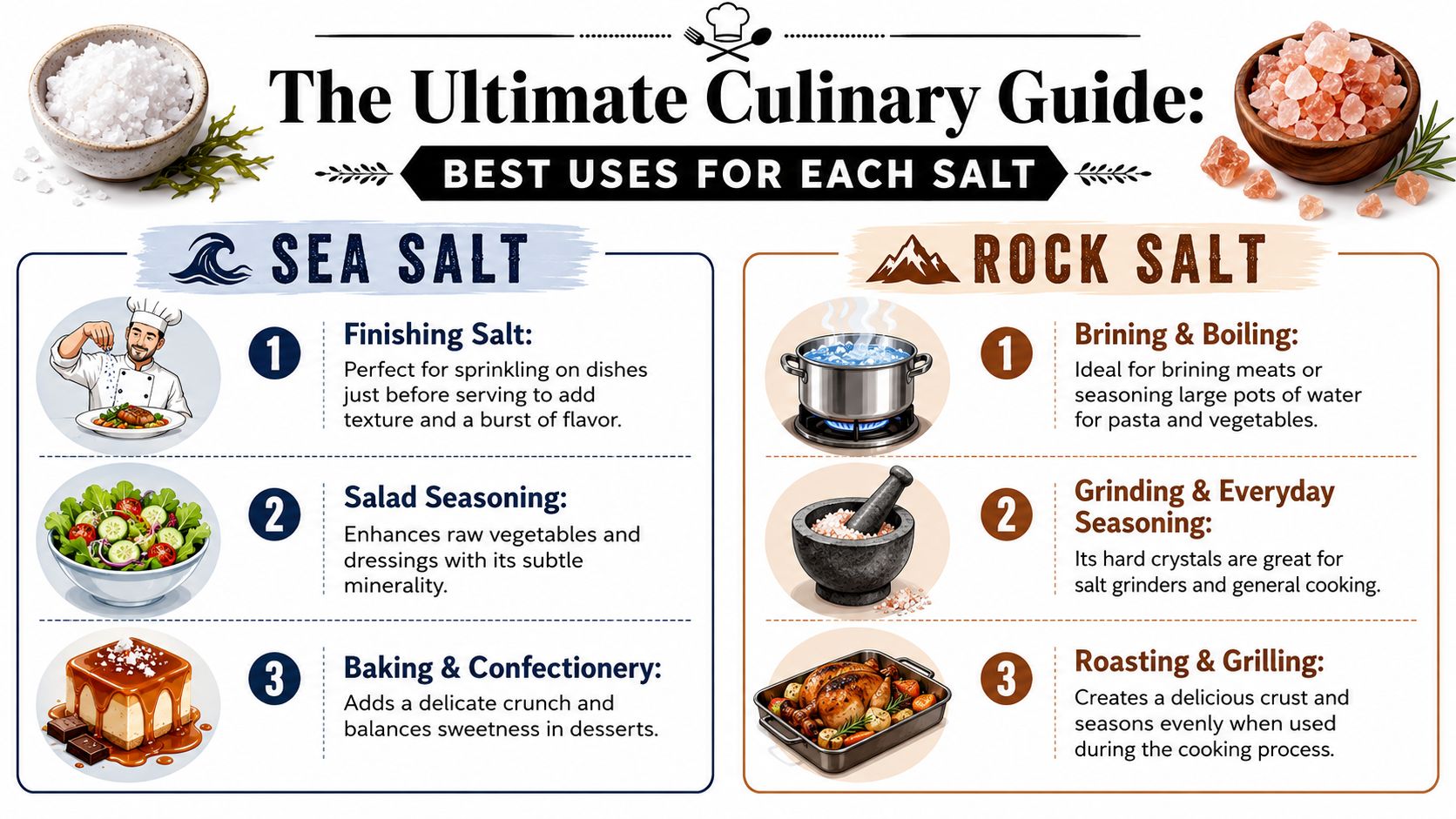
Flaky or delicate sea salt shines when the salt stays visible and noticeable until serving. That makes it a strong choice for finishing roasted vegetables, avocado toast, grilled fish, shortbread, brownies, and chocolate desserts.
Fine sea salt is also useful in everyday cooking when you want quicker dissolving than a very coarse salt gives you. It works well in vinaigrettes, pan sauces, scrambled eggs, and soups where you want the seasoning to distribute quickly.
A good rule for sea salt is simple:
- Finishing food: Use flaky crystals for crunch and visual appeal.
- Fast-mixing dishes: Use fine sea salt when you want quick dissolving.
- Desserts: Reach for flakes, not hard chunks.
If you bake bread regularly, dough is one place where precision matters more than salt branding. This guide on understanding salt in breadmaking is helpful because it focuses on function inside the dough, not just on shelf appeal.
Use rock salt when coverage and control matter
Rock salt is often better when you want sturdier crystals, bulk use, or a salt that behaves well in a grinder. It's practical for seasoning large pots of water, some brining applications, grinder refills, and certain roasting jobs where a sturdier crystal makes sense.
Very coarse rock salt is also useful when the goal isn't immediate dissolution. Some cooks like it for salt crust preparations or for situations where the crystal needs to hold its shape longer before melting into the food.
One helpful pantry system is to think in roles:
- Daily seasoning salt for stovetop cooking
- Finishing salt for the table
- Coarse utility salt for grinders, brines, or big cooking jobs
That setup keeps you from wasting expensive finishing salt in pasta water or trying to top cookies with salt that feels like gravel.
A few more seasoning ideas live in these seasoning tips for home cooks, especially if you're trying to make your recipes more consistent across weeknight meals.
Harvard Health and Mayo Clinic confirm that salts are largely sodium chloride, but a useful practical note captured in this discussion about salt crystal size and spoon measurements is that larger rock salt crystals mean fewer fit in a spoon. That's why measuring by volume can lead to under-salting.
Here's a useful visual explanation before you keep reading:
How to substitute without ruining a recipe
Most salt substitution mistakes happen because cooks swap by volume instead of by weight. A tablespoon of fine salt doesn't behave like a tablespoon of coarse salt. That's true whether the salt is from the sea or from a mined deposit.
When you need to substitute, use this approach:
- If the salt is dissolved into a liquid: Start with less if your substitute is finer, then taste.
- If the salt is a finish: Match the texture first. A crunchy garnish needs a crunchy salt.
- If it's baking or bread: Weigh it whenever possible.
Kitchen shortcut: If a recipe came from TikTok or Instagram and the salt measure looks casual, assume the creator may be using a very different crystal size than yours.
That single habit prevents a lot of disappointing dinners.
Storing Your Salt and Cost Considerations
Salt is durable, but it isn't invincible. Humidity turns a free-flowing jar into a clumpy brick fast, especially if the crystals are flaky or slightly moist to begin with.
How to keep salt free-flowing
Store cooking salts in airtight containers away from steam, not right above the stove. A small jar by the cooktop is fine if you refill it often, but bulk salt should live in a dry cabinet. If a salt tends to clump, many home cooks still use the old rice trick in a container that isn't meant for finishing at the table.
Texture matters here too. Flaky sea salts can crush if they're packed tightly, while very coarse rock salts are less fragile but can still absorb moisture over time. Grinder salts need special attention. If the crystals are damp, they can jam the mechanism.
Kitchen storage habits usually overlap. If you're tightening up your pantry overall, these garlic storage tips are worth a read because the same idea applies: protect ingredients from moisture, heat, and bad placement. Container choice matters too, and this comparison of plastic vs stainless steel food storage key differences can help if you're reworking how your pantry is organized.
Where to save and where to splurge
This is one ingredient category where spending selectively makes sense. Use less expensive salt for jobs that don't showcase texture. Pasta water, soup pots, brines, and general cooking don't need your prettiest finishing flakes.
Save the nicer sea salt for places where you can feel and see it. A pinch on sliced peaches, dark chocolate cookies, grilled asparagus, or a finished steak is where specialty salt earns its keep.
A practical buying pattern looks like this:
- Buy bulk for cooking: Use an everyday salt you won't hesitate to use generously.
- Buy small for finishing: Flaky specialty salts last longer when used as accents.
- Skip prestige purchases that solve no kitchen problem: If two salts do the same job in your cooking, choose the one that's easier to handle.
Common Salt Questions for Home Cooks
A few salt questions come up again and again because packaging doesn't make them any clearer.
Is Himalayan pink salt a rock salt
Yes. Himalayan pink salt is a rock salt, which means it comes from mined deposits rather than evaporated seawater. In the kitchen, think of it as a mined salt with its own color and texture, not as a separate category that rewrites the usual rules.
Can you put sea salt in a grinder
Sometimes. Dry, coarse sea salt usually works better than damp sea salt. If the crystals hold moisture, the grinder may clog or grind unevenly. For mills, hard and dry crystals tend to behave best.
Where iodized table salt fits
Iodized table salt is the highly practical, no-nonsense option in many kitchens. It's often refined salt with iodine added. If your cooking depends on easy measuring and quick dissolving, it does the job well.
Mayo Clinic notes that both sea salt and table salt contain approximately 40% sodium by weight, so their primary nutritional value is the same despite sea salt's healthier image in the marketplace, as explained in this Mayo Clinic answer on sea salt and table salt.
For most home cooks, the simplest takeaway is this:
- Choose by use, not by hype
- Match crystal size to the recipe
- Reserve fancy salt for places where texture matters
Keeping track of which recipe uses flaky sea salt, coarse grinder salt, or fine everyday salt gets messy fast when your collection is spread across screenshots, social posts, cookbooks, and handwritten notes. OrganizEat gives your recipes one organized home, so you can save them, tag them, plan meals, build shopping lists, and keep track of which version worked best in your kitchen.