




Your refrigerator stops cooling on a Thursday night. Milk is warming up, leftovers are at risk, and you’re searching for help fast. Or maybe you’ve walked past a painted fridge on a sidewalk and wondered why strangers stock it with produce, yogurt, or sealed meals.
That’s where a lot of confusion starts. The phrase free fridge program sounds simple, but people use it to mean very different things. Sometimes they mean a community fridge where anyone can take or leave food. Sometimes they mean a household appliance program that helps a family get a refrigerator. Other times they mean a utility rebate or recycling offer that reduces the cost of replacing an old unit.
If you’ve felt lost trying to sort that out, you’re not alone. The right path depends on what problem you’re trying to solve right now: food for today, a working refrigerator for your home, or a cheaper way to upgrade. If your main stress is stretching groceries while dealing with a broken fridge, pairing local assistance with a budget meal planning routine can also help reduce waste while you figure out next steps.
Table of Contents
- What Does a Free Fridge Program Really Mean
- The Three Types of Free Fridge Programs Explained
- How Community Fridges Work and How to Participate
- Finding a Free Refrigerator Appliance for Your Home
- Using Utility Programs to Get a Deeply Discounted Fridge
- Important Safety and Legal Considerations
- A Quick Guide to Starting Your Own Community Fridge
What Does a Free Fridge Program Really Mean
When people search for a free fridge program, they’re often mixing together three unrelated kinds of help. That’s why the search results feel messy. One result talks about mutual aid, another talks about utility rebates, and another talks about low-income appliance assistance.
The simplest way to sort it out is to ask one question first: Do you need food, do you need a refrigerator, or do you need help lowering the cost of replacing one? Your answer points to a different program.
Here’s the plain-language version:
- If you need food now, you’re probably looking for a community fridge.
- If your home fridge is broken or missing, you’re probably looking for appliance assistance.
- If you have an old fridge and want a cheaper upgrade, you’re probably looking for a utility rebate or recycling program.
Practical rule: Don’t start by searching for “free fridge” alone. Search for the problem you need solved, such as “community fridge near me,” “low income refrigerator assistance,” or “utility refrigerator rebate.”
People also get tripped up by the word free. In one setting, free means free food that neighbors share. In another, it may mean a subsidized appliance if you meet income rules. In a third, it means part of the cost is offset through a rebate, pickup service, or recycling incentive.
That difference matters because each option has its own rules, timeline, and paperwork. A community fridge can help today. Appliance assistance may take an application and approval. Utility programs usually work best when you already have a unit to trade in or recycle.
The Three Types of Free Fridge Programs Explained
Think of these programs like three different community tools that happen to involve a refrigerator. They sit under the same search term, but they serve different jobs.
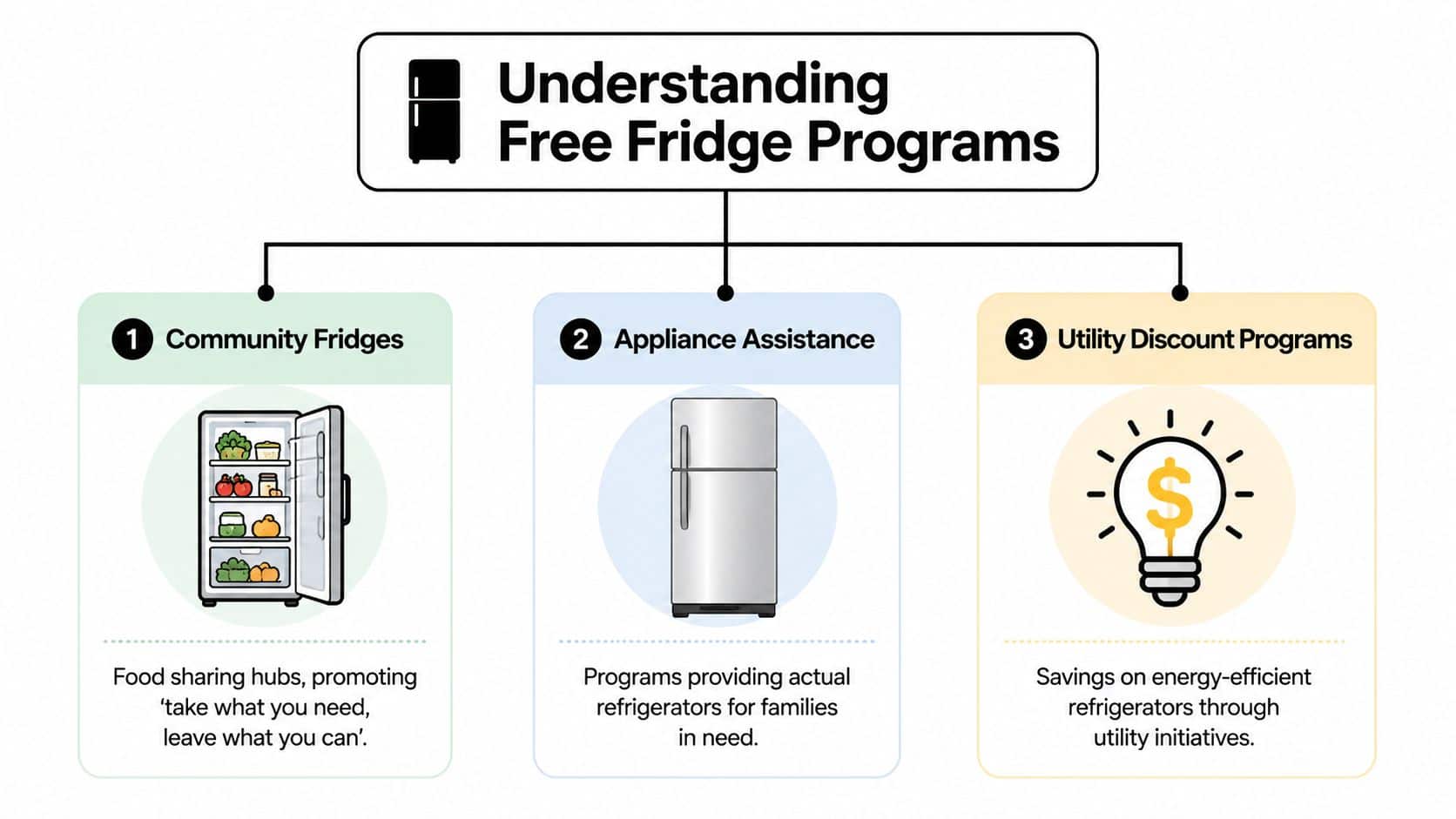
Community fridges
A community fridge is a shared food access point. People and local businesses stock it, and neighbors take what they need. These fridges surged in popularity during the COVID-19 pandemic and operate as 24/7 donation-based refrigeration points that help fill gaps in fresh food access, as described in Consumer Reports’ overview of community fridges.
This is the version many people see on sidewalks, church properties, outside community centers, or next to little free pantries. The goal isn’t to give someone a refrigerator appliance. The goal is to move food directly to people.
What “free” means here: free access to donated food.
Appliance assistance
This type of free fridge program is about a household appliance, not shared food. A local agency, nonprofit, state energy office, or assistance program may help a qualifying household replace a broken, unsafe, or highly inefficient refrigerator.
This category often serves renters, seniors, families with children, people with low incomes, and households already connected to assistance systems. These programs may fully cover a fridge, partially cover it, or connect the household to another funding source.
What “free” means here: the family may receive a refrigerator at no cost, or at a greatly reduced cost, if they qualify.
Utility rebate and recycling programs
This category usually isn’t free upfront, but it can still be the smartest financial option. A utility company may offer a pickup service for an older refrigerator, plus a rebate, credit, or efficiency incentive tied to replacing that unit.
This path is common for households that don’t qualify for direct assistance but still want relief from high operating costs. Utilities like these programs because old refrigerators often waste electricity.
What “free” means here: free pickup, a rebate, or a discount that lowers the total cost of upgrading.
A quick comparison
| Program type | Best for | What you receive | Main catch |
|---|---|---|---|
| Community fridge | Someone who needs food quickly | Shared donated food | Rules vary by site |
| Appliance assistance | A household without a working fridge | A refrigerator or funding help | Usually requires eligibility review |
| Utility program | A household replacing an older unit | Rebate, pickup, or discount | Often requires an existing old fridge |
If your need is immediate hunger, a community fridge is the fastest fit. If your kitchen has no safe refrigerator at all, look for appliance help. If your old unit still runs but costs too much to keep, check your utility first.
How Community Fridges Work and How to Participate
Community fridges run on a simple idea: take what you need, leave what you can. That can look different from one neighborhood to another, but the spirit is the same. A person drops off extra produce after a market trip. A restaurant adds sealed items. A parent picks up fruit, milk, or ready-to-eat food on the way home.
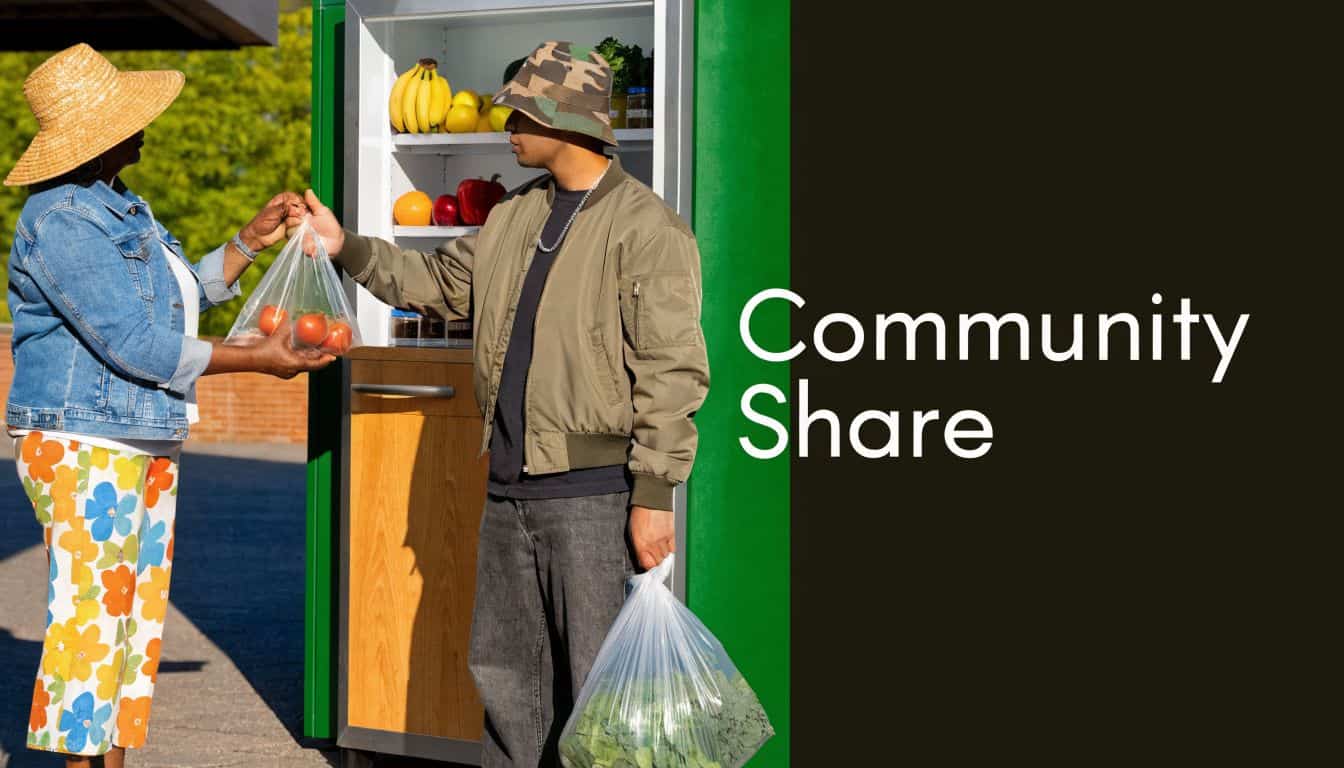
The best community fridges feel easy to use. There’s no interrogation, no awkward line, and no pressure to “prove” need. That’s one reason they’ve become such a practical mutual aid tool.
What you’ll usually find at a community fridge
You might find fresh vegetables, sealed drinks, packaged dairy, bread, or labeled grab-and-go items. Some fridges also have shelves nearby for pantry goods and hygiene supplies.
Common donations often include:
- Fresh produce that’s still in good shape
- Sealed packaged foods that haven’t expired
- Store-bought prepared items in original packaging
- Bread and baked goods if local rules allow them
- Pantry overflow placed on adjacent shelves rather than inside the fridge
A good way to think about it is this: donate food you’d feel comfortable handing directly to a neighbor.
How to donate without creating problems
The hard part isn’t generosity. It’s food safety. That matters most when home cooks want to share homemade soups, casseroles, or extra portions from family recipes.
Data from The Freedge Network reported by Nourishing Neighbors’ article on community fridges shows 68% of community fridges reject home-prepared foods because of safety risks. The same source notes the need for clear labeling and temperature control, and references USDA guidance that perishables should stay below 40°F/4°C.
That doesn’t mean you should never bring cooked food. It means you need to check the fridge’s local rules first.
Labeling matters more than people think. If staff or volunteers can’t tell what something is, when it was made, or whether it was kept cold, they may need to throw it out.
If you regularly cook from saved recipes and want to donate safely, use a checklist before leaving home. The same habits that make smarter grocery shopping decisions also help you donate more responsibly, especially when you’re planning meals around extras and leftovers.
Here’s a practical donation checklist:
- Check site rules first. Some community fridges allow homemade food, some don’t.
- Cool food safely before transport. Don’t let perishable food sit out too long.
- Use secure containers that won’t leak.
- Add a clear label with the dish name, main ingredients, date cooked, and a use-by date.
- Avoid risky foods if you’re unsure. When in doubt, donate sealed items instead.
For a closer look at how one community fridge operates in practice, this short video helps put the model into context.
Community fridges also need respectful users on the receiving side. Take what helps your household, close the door carefully, and don’t leave behind damaged containers, open food, or trash. Small habits keep the fridge useful for everyone.
Finding a Free Refrigerator Appliance for Your Home
Needing a refrigerator for your own kitchen is a different kind of emergency. Food access matters, but so does medication storage, baby formula, and being able to cook at home at all. If your household fridge has failed, the right free fridge program is usually an assistance program, not a public food-sharing fridge.
Where appliance help usually comes from
Start with agencies that already handle household hardship or energy efficiency. In many places, refrigerator help is folded into broader housing, weatherization, or appliance support systems instead of being advertised as a stand-alone giveaway.
Good places to check include:
- Community action agencies that handle local assistance applications
- State energy-efficiency programs that include appliance upgrades
- Weatherization channels that review old, inefficient units
- Faith-based or neighborhood nonprofits that sometimes coordinate donated appliances
- Utility-linked low-income programs that bridge part of the cost
The strongest documented path is weatherization-related assistance. The U.S. Department of Energy’s Weatherization Assistance Program allows refrigerator replacement in low-income households under technical rules described in the NASCSP refrigerator toolkit for WAP. That toolkit says agencies use energy audits and approved model standards before replacement.
A separate consumer-oriented source notes that emerging 2025 to 2026 trends show utility rebates filling gaps for low-income households, with NYSERDA programs offering up to $840 for appliances and GE’s Appliances RePower offering credits up to $600, while 15 million U.S. households face fridge failure annually, according to StandUp Wireless’ guide to refrigerator help.
A simple application path
This process feels less overwhelming when you break it into tasks.
-
Write down the exact problem
Is the fridge dead, unsafe, missing, or extremely expensive to run? Be specific. Agencies often route requests based on whether the need is emergency replacement, energy efficiency, or basic household stability. -
Gather documents before you call
Most programs ask for ID, proof of address, proof of income, lease details if you rent, and sometimes a utility bill. Having those ready saves time. -
Call local help hubs, not just big national names
Ask whether they offer direct refrigerator aid, weatherization screening, appliance replacement, or referrals. Local caseworkers often know about programs that don’t show up in a quick search. -
Ask what “approval” means It may mean a direct appliance, a voucher, a rebate path, or placement on a waitlist.
Ask one very direct question: “Do you help people get an actual refrigerator for the home, or do you only offer efficiency advice and referrals?”
If you do receive a donated or discounted unit, plan the move carefully. Large appliances are easy to damage and easy to injure yourself moving. This guide to safe fridge relocation techniques is useful if you need to transport a refrigerator without wrecking the compressor, flooring, or door seals.
The process can be slow, but don’t assume “no” after one call. Refrigerator help is often hidden inside broader programs with names that don’t mention appliances.
Using Utility Programs to Get a Deeply Discounted Fridge
For many households, the best free fridge program isn’t free. It’s a trade-off that saves money over time. If your current refrigerator still runs but hums constantly, freezes one shelf, or spikes your electric bill, a utility program may be the most practical path.
Why utilities want old fridges gone
Utility companies have a reason to pay people to retire older appliances. Old refrigerators can use far more electricity than newer efficient models, especially if they’re from the 1990s or have worn door seals, older refrigerants, or tired compressors.
According to Xcel Energy’s Texas refrigerator recycling program details, participants can receive a $50 cash rebate and free pick-up for an old unit. The same source says replacing a 1990s refrigerator with a 2023 ENERGY STAR equivalent can cut energy demand by 300 to 500 kWh per year and reduce household emissions by 200 to 400 kg annually.
That’s the hidden value. You’re not just getting a small incentive. You’re also stopping an expensive machine from eating away at your budget month after month.
How to shop these programs smartly
Don’t buy first and look for rebates later. Start with your electric utility’s website or customer service line and ask what refrigerator recycling, appliance rebate, or income-qualified efficiency options they currently offer.
Use this decision filter:
- Your old fridge still works, but costs too much. A recycle-and-replace offer may fit.
- You have a second garage fridge. Utilities often want those older extra units off the grid.
- You don’t qualify for low-income aid. A rebate may be your easiest win.
- You’re already shopping for a new unit. Stack store pricing with any utility incentive you can document.
A few questions make the difference:
| Ask this | Why it matters |
|---|---|
| Does the utility pick up the old fridge? | Pickup can remove hauling costs and hassle |
| Does the rebate require a specific model class? | Some offers only apply to certain efficient units |
| Can renters participate? | In some areas, yes, especially with landlord approval |
| Is there a deadline or pre-approval step? | Missing this can void the incentive |
A rebate only helps if the replacement fridge actually fits your kitchen, your outlet setup, and your long-term power budget.
For people who are close to qualifying for assistance but not quite there, this middle path is often the most realistic. It’s not flashy, but it can turn a stressful purchase into a manageable one.
Important Safety and Legal Considerations
A free fridge program only works when people use it responsibly. Food can spoil. Appliances can tip, spark, or leak. Old refrigerators can create disposal problems if nobody handles them correctly.
Food safety in public fridges
Community fridges need rules that ordinary neighbors can follow without guessing. That means clear signage, regular cleaning, and consistent decisions about what gets removed.
The biggest risk area is prepared food. Containers should be sealed, labeled, and kept cold. If a site accepts homemade items, organizers need simple standards for ingredient labeling, prep date, and storage timing. If a site doesn’t accept them, that rule should be visible.
Choosing the right storage supplies helps too. If you’re comparing reusable container options before donating prepared food, this breakdown of plastic and stainless steel food storage differences is useful for thinking through leakage, durability, and transport.
Public food sharing works best when rules are easy to see and easy to follow.
Appliance and disposal safety
Household refrigerator programs come with a different set of risks. The unit should be installed on a suitable outlet, positioned with enough clearance, and checked for door seal issues, damaged cords, and stability.
For public-facing fridges, organizers should think carefully about the refrigerator itself. The spark-free refrigerator market is projected to reach $1,128.54 million by 2033, according to Cognitive Market Research’s spark-free refrigerator market report. That projection points to growing interest in safer units for settings where public access and shared storage increase risk.
Old appliances also need proper disposal. Dumping or informal resale can create environmental hazards, especially when older refrigerants or damaged insulation are involved. Programs that include pickup and verified recycling are usually safer than ad hoc disposal.
A simple rule helps here: if a refrigerator is entering a shared space or leaving service permanently, treat that as a safety event, not a casual handoff.
A Quick Guide to Starting Your Own Community Fridge
A neighborhood fridge starts small and gets stronger when the setup is simple. You need a host site with power, a refrigerator that’s suitable for shared use, and a few people who will check it consistently.
Start with this checklist:
- Pick a visible host location with permission, electricity, and easy walk-up access
- Set written food rules so donors know what’s accepted and what gets removed
- Build a volunteer rhythm for cleaning, checking temperatures, and restocking
- Plan for communication with a sign, local social posts, and a contact method
- Decide how you’ll handle homemade food before the first donation arrives
Some groups run a community fridge informally. Others decide they need a more structured setup, especially if they want fundraising, partnerships, or liability planning. If your project is growing beyond a neighborhood volunteer effort, these Alignmint resources for new organizations can help you think through whether a formal nonprofit structure makes sense.
Keep the first version manageable. A fridge that’s small, clean, and regularly checked will serve people better than an ambitious launch nobody can maintain.
If you’re feeding a household on a tight budget, trying to reduce waste, or organizing recipes and grocery lists while life feels chaotic, OrganizEat can help you keep meals, shopping, and saved recipes in one place so your kitchen runs with less stress.