




You're probably in one of two camps right now. Either you're tired of cooking and searching “meal pro reviews” because you want dinner solved, or you've already looked at a few reviews and noticed they don't seem to agree on what MealPro even is. One person says it's a smart shortcut for disciplined eating. Another says it's overpriced and too narrow. Both can be right.
That's why a straight thumbs-up or thumbs-down review isn't very useful here. MealPro is one of those services where the fit matters more than the hype. If you read reviews without understanding who the service is built for, you'll come away confused. If you read them with the right filter, the patterns get much clearer.
Table of Contents
- Should You Trust Meal Pro Reviews?
- What Meal Pro Actually Sells You
- What Everyone Is Saying About Meal Pro
- Customization and Dietary Options Explained
- Meal Pro Pros Cons and Ideal Customer Profile
- Beyond Meal Kits Alternative Meal Planning Strategies
- Frequently Asked Questions About Meal Pro
Should You Trust Meal Pro Reviews?
You should trust patterns, not isolated opinions.
That matters with MealPro because the reviews are often polarized for predictable reasons. A customer who wants large, protein-forward prepared meals may see the service as efficient and worth the premium. A customer who wants broad menu variety, family-friendly flexibility, or lower weekly food costs may read the same offer very differently. Neither review is necessarily misleading. They're just evaluating different standards.
What to look for in meal pro reviews
When I read meal pro reviews critically, I focus on three things first:
- Reviewer goals: Are they trying to save time, hit macro targets, avoid cooking, or feed a household?
- Reviewer budget expectations: Premium prepared meals will feel reasonable to some shoppers and inflated to others.
- Reviewer definition of customization: Some people mean “I can swap ingredients freely.” Others just mean “I can choose among a few structured options.”
If a review doesn't tell you those basics, it's missing the context you need.
Practical rule: A useful MealPro review says who the service works for. A weak one only says whether the reviewer liked it.
There's also a bigger issue. Subscription food services tend to trigger strong reactions because they sit at the intersection of convenience, health, and recurring cost. If you've ever wondered why so many parts of daily life become subscription purchases, you already know the emotional response can be as strong as the practical one.
The smarter way to read them
Use this quick filter before believing any review:
| Question | Why it matters |
|---|---|
| Who is the reviewer feeding? | A solo gym-goer and a family of four won't judge value the same way. |
| Are they reviewing taste or workflow? | Good flavor doesn't automatically mean a good fit for your routine. |
| Do they mention portions? | Portion size is one of the biggest dividing lines in MealPro feedback. |
| Do they mention price tolerance? | Premium services get judged harshly when readers expect budget convenience. |
The goal isn't to decide whether the reviews are honest. It's to decide whether they're relevant to your life.
What Meal Pro Actually Sells You
MealPro isn't trying to be an all-purpose meal service for everyone. Its public positioning has long leaned toward fitness-oriented prepared food rather than broad lifestyle convenience.
A historical review highlighted by FoodBoxHQ's coverage on YouTube describes MealPro as a high-end pre-made meal service for fitness enthusiasts, with portions designed for people trying to bulk up or cut. The same review also notes a loyalty and rewards structure where customers earn points with each purchase. That combination tells you a lot before you even read user feedback.
This is a targeted offer, not a general one
MealPro's core pitch seems built around a repeat customer who values consistency. That customer likely cares about protein, portion control in a broad sense, and reducing cooking time without moving into casual takeout habits.
That's different from how many home cooks think about meal services. Plenty of people want dinner inspiration, family flexibility, or more adventurous variety across the week. MealPro's older positioning suggests it has been speaking to a narrower audience for a long time.
Here's the practical implication. Reviews from strength-focused eaters and reviews from general home cooks can sound like they're describing two different companies, because they're judging the service against different jobs.
The loyalty angle matters too
The rewards element is easy to overlook, but it explains why some reviews come from repeat customers with a settled routine. A points program encourages habit. It makes more sense for a service that expects people to order again and again, not just occasionally test it.
That can shape review tone in two ways:
- Repeat buyers may value predictability more than novelty
- First-time buyers may judge the service more harshly on price and menu breadth
MealPro makes the most sense when you see it as a structured prepared-food system for a specific kind of eater, not as a replacement for all weekly meal planning.
Read the branding before the testimonials
If you want to interpret meal pro reviews accurately, start with the company's intended customer:
| Signal | What it suggests |
|---|---|
| Fitness-oriented messaging | The meals are likely optimized around performance-minded eating habits |
| Bulking and cutting language | Portion sizing and macro awareness matter more here than culinary exploration |
| Rewards program | The business is built to encourage repeat orders and routine use |
| Satisfaction-focused review presence | Trust-building has been part of the public-facing strategy for years |
Once you see that, a lot of the review contradictions stop looking contradictory.
What Everyone Is Saying About Meal Pro
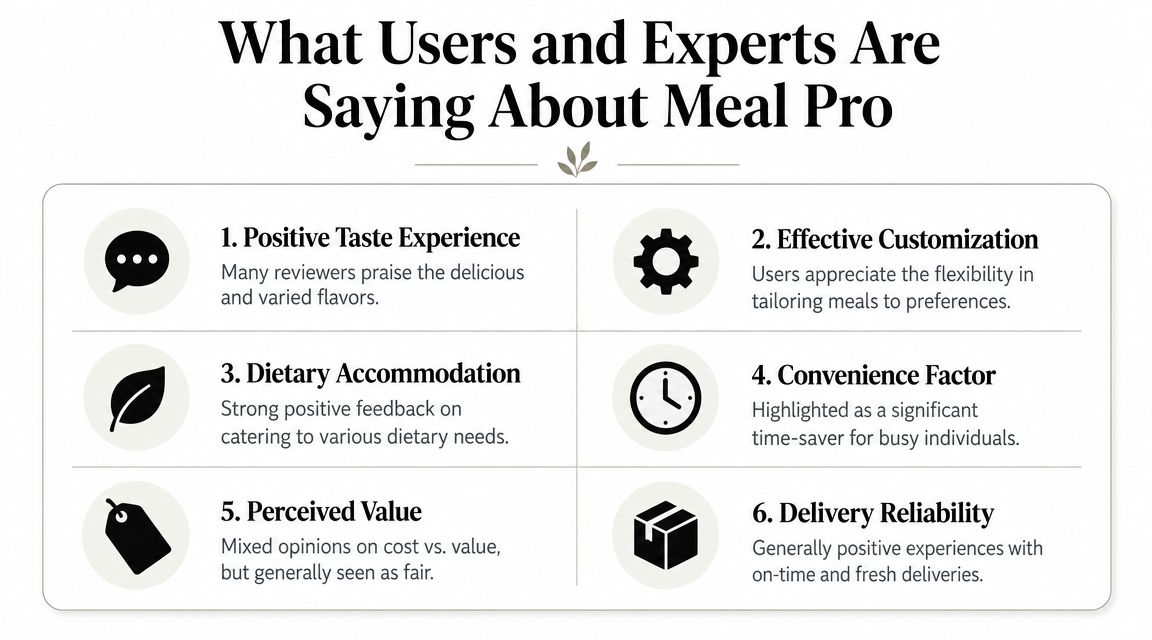
The strongest review themes around MealPro cluster around portion size, value, and menu variety.
A 2026 Deliveryrank review of MealPro says the service typically offers around 30 weekly prepared meals, with rotation across cuisines including Japanese, American, Italian, and Latin American. That same review notes a weekly mix that can include roughly 8 beef, 7 seafood, 11 poultry, and 6 veggie dishes, and concludes that MealPro is best for customers who want large portion sizes and don't mind expensive meals and high shipping costs.
That's the clearest lens for reading the broader feedback.
The praise usually centers on utility
People who respond well to MealPro tend to like the service for practical reasons more than romantic ones. They want prepared meals ready to support a routine. They aren't looking for a fun cooking experience.
The most consistent positives in meal pro reviews usually sound like this:
- Large portions: Bigger servings can feel like real value if you eat with appetite or train regularly.
- Prepared-meal convenience: The appeal is speed and reduced planning, not scratch cooking.
- Enough variety for routine eaters: A rotating menu can feel sufficient if you prefer repeated structure over constant novelty.
That last point is important. A menu can be “varied enough” for one kind of customer and “too limited” for another.
The complaints usually come from mismatch
The same features that attract the right customer can repel the wrong one.
If you expect bargain pricing, MealPro is likely to disappoint. If you expect a giant menu with broad lifestyle flexibility, the offering may feel narrow. If you don't need large portions, paying premium prices for them can feel inefficient rather than generous.
A lot of MealPro criticism isn't about quality in isolation. It's about paying for a format the reviewer didn't actually need.
The recurring trade-offs
Here's the cleanest way to interpret the review environment:
| Review theme | When it reads as a strength | When it reads as a weakness |
|---|---|---|
| Portion size | Helpful for bigger appetites and performance-focused eaters | Too much food for lighter eaters |
| Price | Acceptable when convenience and portion size matter most | Hard to justify if budget is the priority |
| Menu size | Fine for repeatable weekly routines | Restrictive if you get bored easily |
| Prepared format | Saves time and decision-making | Less appealing for people who enjoy cooking |
The phrase “premium prepared meal service” matters more than most shoppers realize. It tells you not to evaluate MealPro like a grocery substitute or a low-cost lunch hack. It's a convenience product with a more defined user profile than many review roundups admit.
Customization and Dietary Options Explained
Many meal pro reviews get fuzzy. They use the word “customizable” without explaining what kind of customization you're getting.
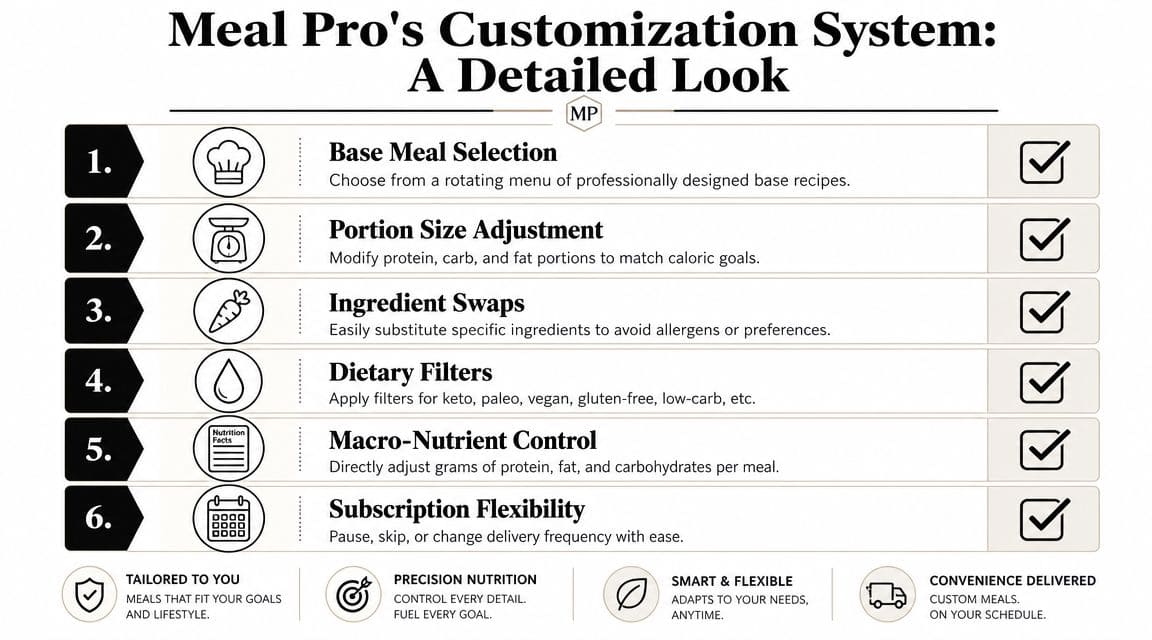
MealPro appears to use category-based selection plus add-ons, not open-ended ingredient-level editing. A review summary published at Revgear's MealPro review page says the service supports high-protein, low-sodium, pescatarian, dairy-free, soy-free, and paleo-friendly choices, and notes that some meals can be adjusted downward in carb content. The same source also says MealPro does not offer a dedicated keto program and has limited meatless coverage, making it less suitable for vegan or vegetarian diets.
What MealPro customization seems to mean
In practical terms, MealPro customization looks more like this:
- You choose within a structured menu
- You may add options such as extra protein, double vegetables, or reduced-carb versions
- You don't get full ingredient-by-ingredient control like a scratch-cooking workflow
That distinction matters a lot if you manage allergies, follow strict dietary rules, or dislike certain ingredients.
Who this works for and who may struggle
This model works best for people who want a controlled, repeatable system. If your main goal is “help me stay roughly aligned with a high-protein eating plan without cooking,” MealPro's structure can make sense.
It works less well when your needs are highly specific.
- Good fit: high-protein eaters, some paleo-leaning customers, some pescatarians, people trying to keep meal decisions simple
- Mixed fit: lower-carb eaters who don't require a strict keto framework
- Weak fit: vegans, many vegetarians, and shoppers who need fine-grained ingredient editing
If your diet depends on exact ingredient exclusions, don't stop at the word “customizable.” Find out whether you can edit components or only choose among preset versions.
For readers who need a stronger system for handling restrictions across a whole household, this guide to planning meals for dietary restrictions is a more useful framework than relying on product labels alone.
A simple test before you order
Ask yourself these three questions:
-
Do I need flexibility or control?
Flexibility means selecting among suitable options. Control means editing the meal itself. -
Is my goal nutritional direction or strict compliance?
MealPro appears better for directional eating patterns than rigid protocols. -
Am I feeding just myself?
Structured customization usually works better for one person's routine than for multiple people with competing needs.
That's the difference between a service that feels efficient and one that feels limiting by the second week.
Meal Pro Pros Cons and Ideal Customer Profile
MealPro is easiest to judge once you stop asking whether it's “good” and start asking for whom it's useful.
For the right customer, it solves a real problem. For the wrong one, it creates a new problem by charging premium prices for convenience they don't value enough.
The short verdict
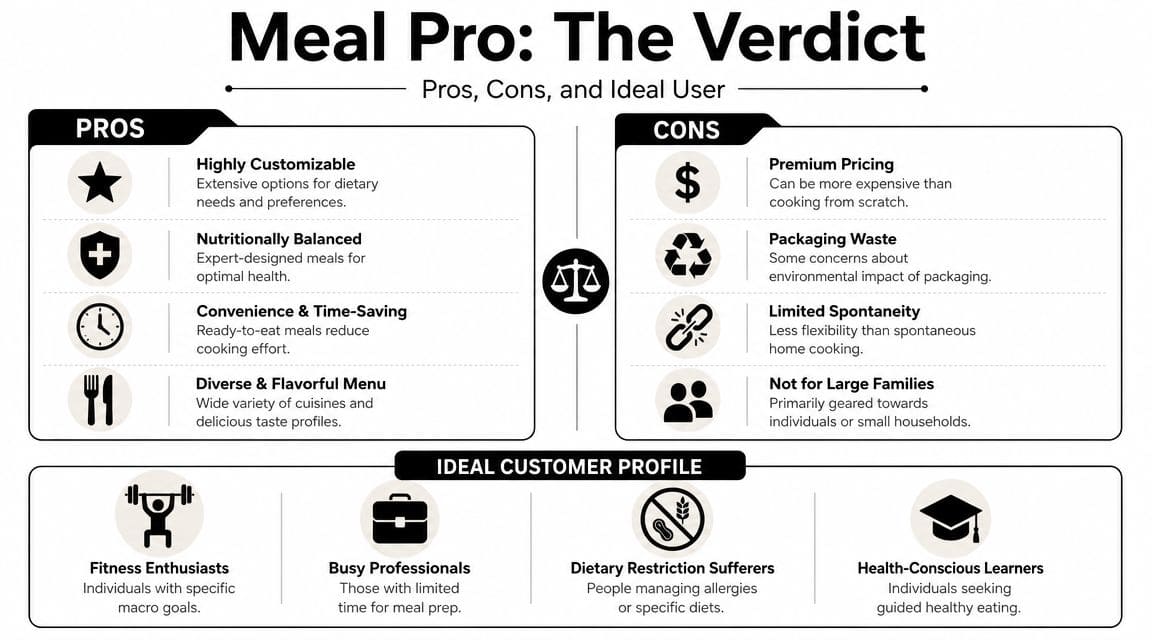
Here's the clean summary.
Pros
- Prepared convenience: You skip most of the planning and cooking burden.
- Portion-forward approach: Useful if standard prepared meals usually leave you hungry.
- Structured meal choices: Better for routine than for endless decision-making.
- Fitness-oriented fit: More aligned with performance-minded eating than casual grazing.
Cons
- Premium cost profile: This isn't the service to choose if budget is your main filter.
- Shipping can add friction: Cost sensitivity increases quickly when delivery feels expensive.
- Limited fit for plant-based eaters: If you want extensive vegetarian or vegan coverage, this likely won't feel broad enough.
- Not highly granular: Some people will call it customizable, but it isn't the same as full meal building.
The ideal customer
MealPro makes the most sense for a person who checks several of these boxes:
| Strong fit signals | Weak fit signals |
|---|---|
| You want prepared meals, not ingredients to cook | You enjoy cooking and only need occasional inspiration |
| You care about high-protein structure | You need broad plant-based variety |
| You're feeding one person or have simple needs | You're feeding several people with different preferences |
| You can tolerate premium food spend | You need strict weekly budget control |
| You're happy repeating a system | You get bored quickly and want open-ended variety |
Here’s where I land. MealPro looks most practical for solo adults with clear eating goals, especially people who see food as support for training, workdays, or routine management. It looks much less compelling for budget-minded households, picky families, and anyone who needs broad customization.
A video overview can also help if you want to compare the service’s presentation with the review patterns discussed above.
What often works in real life
MealPro is strongest as a backup system. Think lunch insurance, post-workout meals, or a no-thinking weekday dinner plan. It’s weaker as a complete answer to all food needs, especially if your preferences shift a lot week to week.
That distinction matters because many disappointed customers expect one service to solve nutrition, variety, budgeting, and family logistics all at once. MealPro doesn’t appear built for that.
Beyond Meal Kits Alternative Meal Planning Strategies
A common Meal Pro review pattern goes like this. The food sounds convenient, the protein looks appealing, then the buyer realizes the service still does not solve the harder part of eating well every week. It does not decide what the rest of the household wants, stretch a grocery budget, or turn scattered recipe ideas into a workable plan.
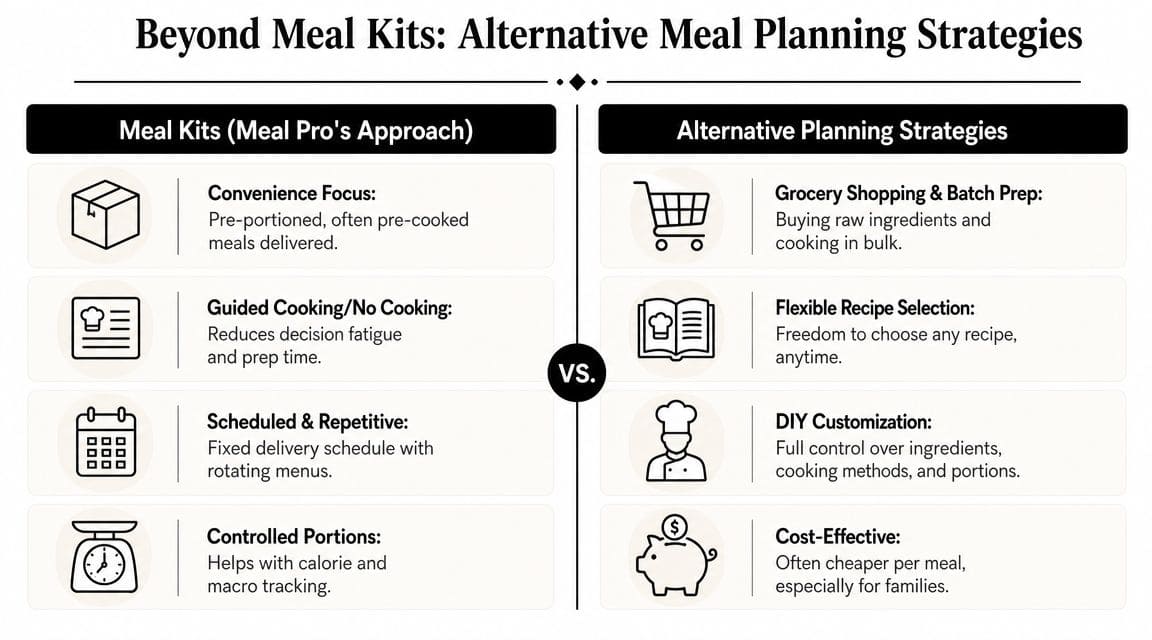
If that sounds familiar, compare MealPro against your current system, not against an ideal version of yourself. Prepared meals buy back time and reduce decision fatigue. A self-run plan usually costs less and gives you more control over ingredients, portions, leftovers, and repeat favorites.
When a self-managed system makes more sense
Home meal planning tends to work better in a few specific situations:
- You need tighter budget control: Groceries and batch cooking usually scale better for couples, families, and anyone watching weekly spend.
- You need ingredient-level precision: Allergies, intolerances, and very specific preferences are easier to handle in your own kitchen.
- You get bored fast: Rotating your own recipes gives you more variety than a fixed prepared-meal menu.
- You care about waste and storage: Cooking at home makes it easier to reuse containers, repurpose leftovers, and buy in larger formats.
If packaging is part of the decision, practical habits around choosing eco-friendly meal prep solutions matter more once you start batch cooking and storing your own meals.
A workable middle ground
You do not need to choose between expensive prepared meals and cooking from scratch every night. The most sustainable setup for many home cooks sits in the middle.
Start with a repeatable base:
- Use the same two or three breakfasts each week.
- Keep lunches simple and easy to prep ahead.
- Rotate a short list of reliable dinners.
- Prep one staple item in bulk, such as rice, roasted vegetables, or a protein.
- Keep a few freezer or pantry backups for chaotic days.
That kind of system removes a lot of friction without locking you into a subscription. OrganizEat can help you store recipes, sort them into folders, build grocery lists, and map meals onto a calendar so your plan stays in one place. If your bigger goal is spending less, this guide to meal planning on a budget is the more useful next step.
Often, the best alternative to MealPro is a tighter kitchen system that fits how you shop, cook, and eat.
Frequently Asked Questions About Meal Pro
Is MealPro good for weight loss or more for muscle gain
It looks more naturally aligned with people who prioritize high-protein structure and larger portions. That doesn’t make it unusable for weight loss, but it means you should look carefully at portion style and meal selection rather than assuming the service is built around calorie minimization.
Is MealPro a good option for vegetarians or vegans
Probably not for many in those groups. Earlier review coverage points to limited meatless options, which makes it a weaker fit if plant-based variety is a primary need rather than an occasional preference.
How much customization do you really get
Think structured customization, not full control. MealPro appears to let customers work within preset meals and use add-ons or adjusted versions, but not rebuild dishes ingredient by ingredient.
Who is most likely to be happy with it
The best fit is someone who wants prepared meals with a fitness-friendly bias, has a steady routine, and can accept premium pricing in exchange for convenience. The weakest fit is someone feeding multiple people on a tight budget or someone with strict ingredient-level requirements.
If MealPro doesn’t match the way you cook and eat, building your own system is often the better answer. OrganizEat gives you one place to save recipes, organize them by category, plan meals on a calendar, and turn ingredients into shopping lists, which is useful when you want more control than a prepared-meal subscription can offer.