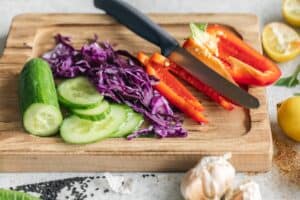



Dinner is half-cooked, the pan is hot, and the vegetables in front of you are all different sizes. A few pieces are mushy before the rest are even tender. That's usually not a seasoning problem. It's a knife-cut problem.
Restaurants don't get that polished, even result by luck. They rely on a shared cutting language that came out of classical French kitchen training, where cuts like julienne, brunoise, chiffonade, paysanne, and mirepoix were standardized by size and use rather than by appearance alone, as outlined in this overview of classical vegetable cuts and dimensions. That standardization still matters because uniform pieces cook at the same pace, release flavor differently, and give a dish a cleaner texture.
The good news is that you don't need restaurant speed to benefit from it. You only need a sharp knife, a stable cutting board, and a short list of cuts you can recognize and repeat. Once you understand why a carrot should be sliced one way for soup and another for stir-fry, prep gets faster and recipes become easier to trust.
These are the types of vegetable cuts worth knowing first. Some are precise. Some are forgiving. All of them earn their place in a home kitchen.
Table of Contents
- 1. Julienne
- 2. Brunoise
- 3. Chiffonade
- 4. Dice
- 5. Mince
- 6. Batonnet
- 7. Allumette
- 8. Oblique or Bias Cut
- 9. Rondelle or Round Slice
- 10. Paysanne
- Quick Comparison of 10 Vegetable Cuts
- Turn Your Kitchen Prep into a Practice
1. Julienne
Julienne is the cut that teaches discipline fast. You're aiming for thin matchstick-style strips, and common guides describe julienne in the range of about 1/8 to 1/4 inch, depending on the teaching style, with thin, even pieces used where quick cooking matters, as shown in this knife-cut guide with common size ranges.
That shape is useful because it gives you speed without turning the vegetable into mush. Carrots in pho garnish, bell peppers in a stir-fry, or beets in a salad all benefit from that thin, tidy structure. They soften quickly, but they still read as vegetables instead of disappearing into the dish.
Why Julienne Works
Julienne is one of the best types of vegetable cuts for high-heat cooking. Thin strips expose more surface area, so they heat fast and take on dressing, sauce, or seasoning evenly. If your stir-fried vegetables are sometimes raw in the center and limp at the edges, uneven julienne is usually the culprit.
A practical trick is to cut the vegetable into shorter lengths before making the final strips. Long carrots and zucchini are awkward to control, and awkward vegetables lead to crooked cuts.
Practical rule: Make flat sides first. Round vegetables roll, and rolling vegetables cause bad cuts.
A mandoline or julienne peeler can help, especially on busy weeknights. If you keep recipes organized by prep style, it's smart to save your favorite matchstick-heavy dishes in a knife-skills collection like the one on OrganizEat's knife skills tag, then open them in Cooking Mode while you prep.
2. Brunoise
Brunoise is tiny, deliberate, and unforgiving. Technically, it's a very fine dice of roughly 2 to 3 mm, and that small size is exactly why it behaves differently in a pan or broth, as explained in this reference on essential precision vegetable cuts.
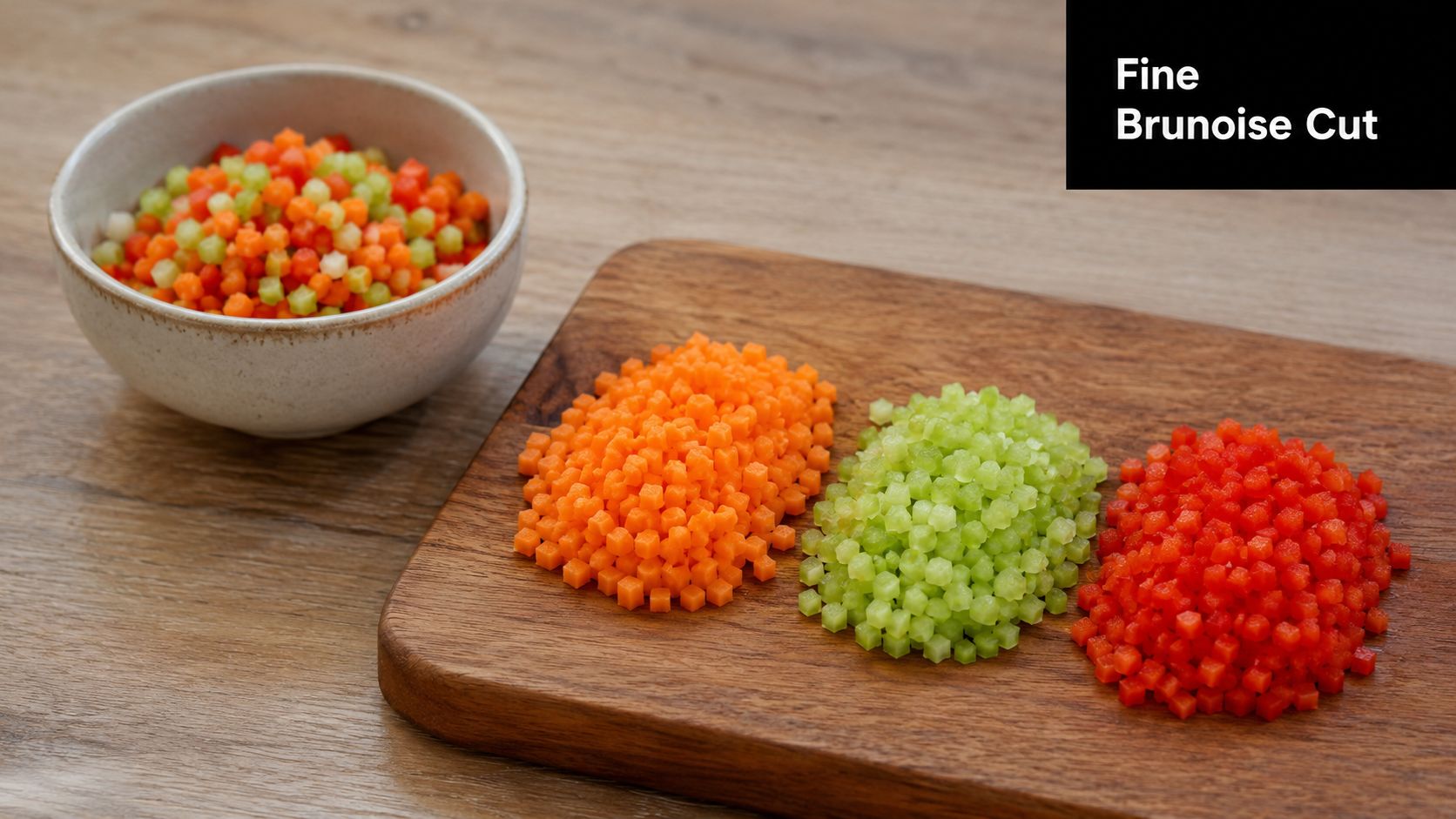
Use it when you want vegetables to blend into a sauce, float neatly in consommé, or finish a plate with clean detail. Carrot, celery, tomato, and shallot all work well here. Onion can work too, but only if your knife is sharp enough to cut cleanly instead of crushing it.
How to Keep It Precise
The cleanest path to brunoise is simple. First make julienne, then turn the strips and cut across them into tiny cubes. Trying to jump straight to miniature cubes usually gives you uneven fragments.
Brunoise rewards patience more than speed. I'd rather see a home cook make a careful small batch than rush through a whole board and end up with half mince, half dice. If the pieces vary too much, some melt away while others stay firm.
Here's a useful visual reference before you practice further:
If you're learning, carrots and potatoes are easier than tomatoes. Take a photo of your best attempt and save it beside the recipe in OrganizEat. That gives you a real benchmark the next time a dish calls for finesse rather than just “finely chopped.”
3. Chiffonade
A bowl of pasta or soup can be fully cooked and still look unfinished until the herbs go on. Chiffonade solves that. It turns leafy herbs and greens into thin ribbons that spread evenly, soften quickly, and give each bite a little flavor instead of dropping one big leaf on top.
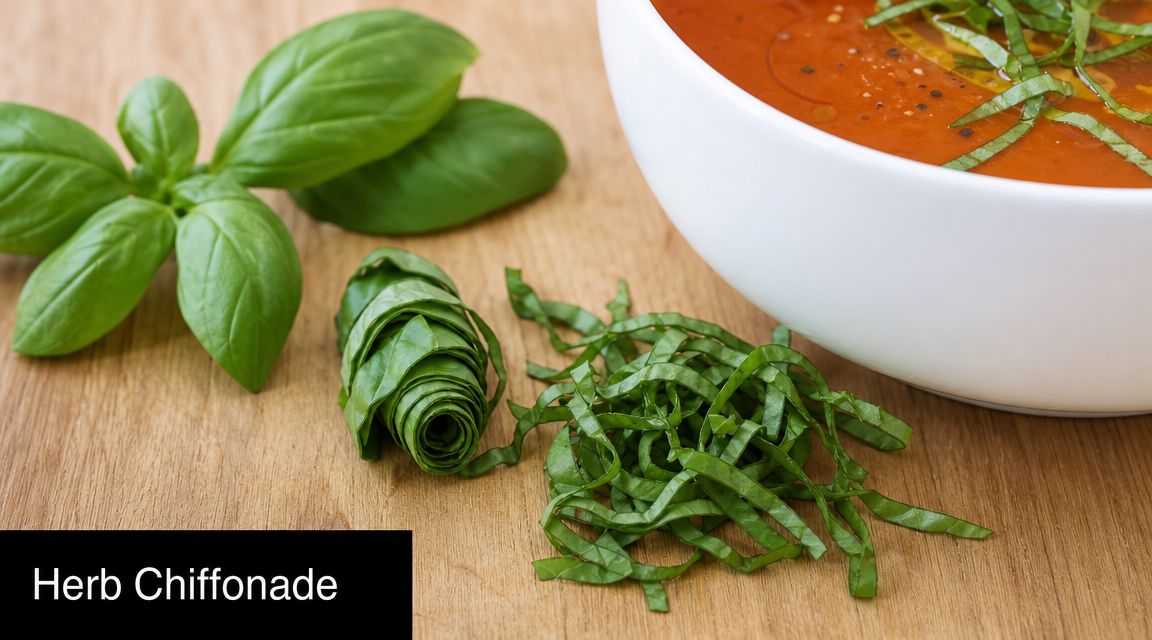
Use it for basil, mint, spinach, sage, and similar leaves. The shape matters. Fine ribbons wilt faster than torn leaves, release aroma sooner, and sit more neatly on the plate. That is why chiffonade works so well as a finish for tomato soup, noodles, pasta, grain bowls, and roasted vegetables.
Best Uses for Chiffonade
Timing matters as much as knife work here. Basil cut too far ahead turns dark. Mint bruises if the blade is dull. Spinach chiffonade can go in earlier because it is often meant to melt into the dish, while basil and mint are better cut right before serving so their color and fragrance stay fresh.
A few habits keep the cut clean and useful:
- Stack only similar leaves: Matching size and texture keeps the pile stable.
- Roll loosely into a cylinder: Tight rolls crush the leaves and squeeze out moisture.
- Slice in one clean motion: A sharp blade leaves clear edges instead of ragged strips.
- Match ribbon width to the dish: Thinner for garnish, slightly wider for greens that need to hold up in hot food.
Knife condition makes a bigger difference here than with heavier vegetables. A sharp chef's knife gives cleaner herb ribbons and less bruising. This guide to chef knife uses for everyday prep is a useful refresher if your cuts keep looking crushed instead of sliced.
I treat chiffonade as a last-minute cut unless the greens are going into heat on purpose. That small choice changes both flavor and appearance.
If you use OrganizEat, add prep notes like “basil chiffonade at serving” or save a photo of the ribbon width that worked best in a favorite recipe. Over time, that turns chiffonade from a restaurant term into a repeatable habit you use on weeknights.
4. Dice
Dice is the workhorse. If a recipe says “chop the vegetables” and gives no further guidance, a dice is often what the dish really wants. Independent cooking guides commonly define dice around 1/4 inch for a standard small dice, and that baseline helps home cooks stay consistent when recipes are vague, as noted earlier in the knife guide reference.
Choosing the Right Dice
The cut changes the dish more than people expect. Small dice disappear into sofrito, salsa, or sauce. Larger dice hold their shape in stew, roasted vegetable trays, and chunky soups.
When I teach this at home, I focus on three questions instead of memorizing labels: Do you want the vegetable to melt, soften, or stay distinct? Once you answer that, the size becomes obvious.
- For soup bases: Dice onion, celery, and carrot evenly so they soften together.
- For chunky dishes: Keep potatoes, squash, or carrots larger so they don't collapse.
- For raw mixes: Small diced cucumber, tomato, or pepper distributes better in salads and relishes.
The best method is plank, stick, then cube. It's cleaner than hacking from random angles, and it gives you straighter sides. If you use OrganizEat, adding a prep note like “small dice onion” or “large dice potatoes” to a saved recipe is one of those tiny habits that makes repeat cooking much easier.
5. Mince
Mince is for ingredients you want everywhere at once. Garlic, ginger, shallots, fresh herbs, and chilies are common examples. Unlike brunoise, mince doesn't need to be perfectly cubic. It needs to be very small and evenly distributed enough that no one bite feels oversized.
That's why mincing works so well in dressings, marinades, pan sauces, and quick sautés. The pieces release flavor fast. They also cling to oil, butter, or liquid instead of sitting in isolated chunks.
Where Mincing Beats Dicing
There's a practical difference between a minced onion and a diced onion in a sauce. Diced onion gives texture. Minced onion dissolves more readily into the background. Neither is better in every situation, but they behave differently from the first minute in the pan.
For herbs, use a rocking motion only after the leaves are already gathered and partially cut. If you rock endlessly over fresh parsley or cilantro, the board gets wet and the herbs turn pasty.
A good mince is small enough to disappear into the dish, but not so overworked that it turns into pulp.
Garlic benefits from being flattened first, because that gives you a stable shape and breaks the clove slightly before cutting. If you cook a lot of weeknight meals, organize recipes that rely on minced aromatics in one collection. They're often the fastest dinners because the flavor builds quickly.
6. Batonnet
Batonnet is the sturdier cousin of julienne. Standard descriptions place it around 1/4 inch thick, which makes it noticeably larger and better suited to cooking methods where the vegetable needs to keep its shape, as described in the earlier overview of standardized cuts and dimensions.
This is a strong cut for carrots in braises, potatoes for thick fries, zucchini in skillet dishes, or firm squash in sheet-pan roasts. It cooks faster than large chunks but doesn't vanish the way thinner strips can.
When Batonnet Is the Better Choice
Choose batonnet when you want order without fragility. A julienned zucchini can turn soft very quickly. A batonnet zucchini still has edges and structure after sautéing.
The easiest sequence is short length, then planks, then sticks. If you skip the plank stage, the final pieces usually end up uneven.
- For roasting: Batonnet gives you better browning on multiple sides.
- For braising: The pieces stay recognizable through longer cooking.
- For fries: A thicker cut gives a softer interior and a sturdier bite.
If you're building foundational knife habits, batonnet is worth repeating because it teaches straight lines and parallel cuts. Save recipes that depend on that shape in a dedicated collection such as classic French-style dishes, and keep practice notes nearby with OrganizEat's chef-knife how-to content.
7. Allumette
Allumette sits between julienne and batonnet in feel, even though many cooks blur the terms in everyday use. Think matchstick potatoes for frying, slim carrots for a quick sauté, or beets cut thin enough for salad but sturdy enough to stay crisp.
This is one of those types of vegetable cuts where naming gets messy. Some guides define cut names very strictly, while others use them more loosely. That inconsistency is real, and one practical guide points out how confusing cut-size translation can be across metric and imperial systems, with examples such as julienne at 2 mm by 2 mm by 2 inches and batonnet at 6 mm by 6 mm by 2 inches in one framework, discussed in this article on cross-cuisine knife cut terminology and equivalencies.
How It Differs from Julienne
In home cooking, the useful distinction is this: allumette is often chosen when you want a slim stick that can still stand up to frying or tossing. Potato allumette for fries is a classic example. Too thin, and the pieces overbrown before the center cooks. Too thick, and they lose that matchstick character.
Keep cut potatoes in cold water if you're frying them, then dry them thoroughly before they hit hot oil. Wet allumette cuts steam instead of crisping.
This is also a good batch-prep shape. You can cut several portions of carrots, potatoes, or beets ahead, then assign them to saved recipes by prep time in OrganizEat so you know which dishes turn those sticks into a fast meal.
8. Oblique or Bias Cut
A bias cut earns its place the first time a stir-fry comes together evenly instead of leaving you with half-crisp, half-soft vegetables. Slicing on an angle creates a larger cut face, so the pieces cook faster than thick rounds and pick up more sauce on each bite.
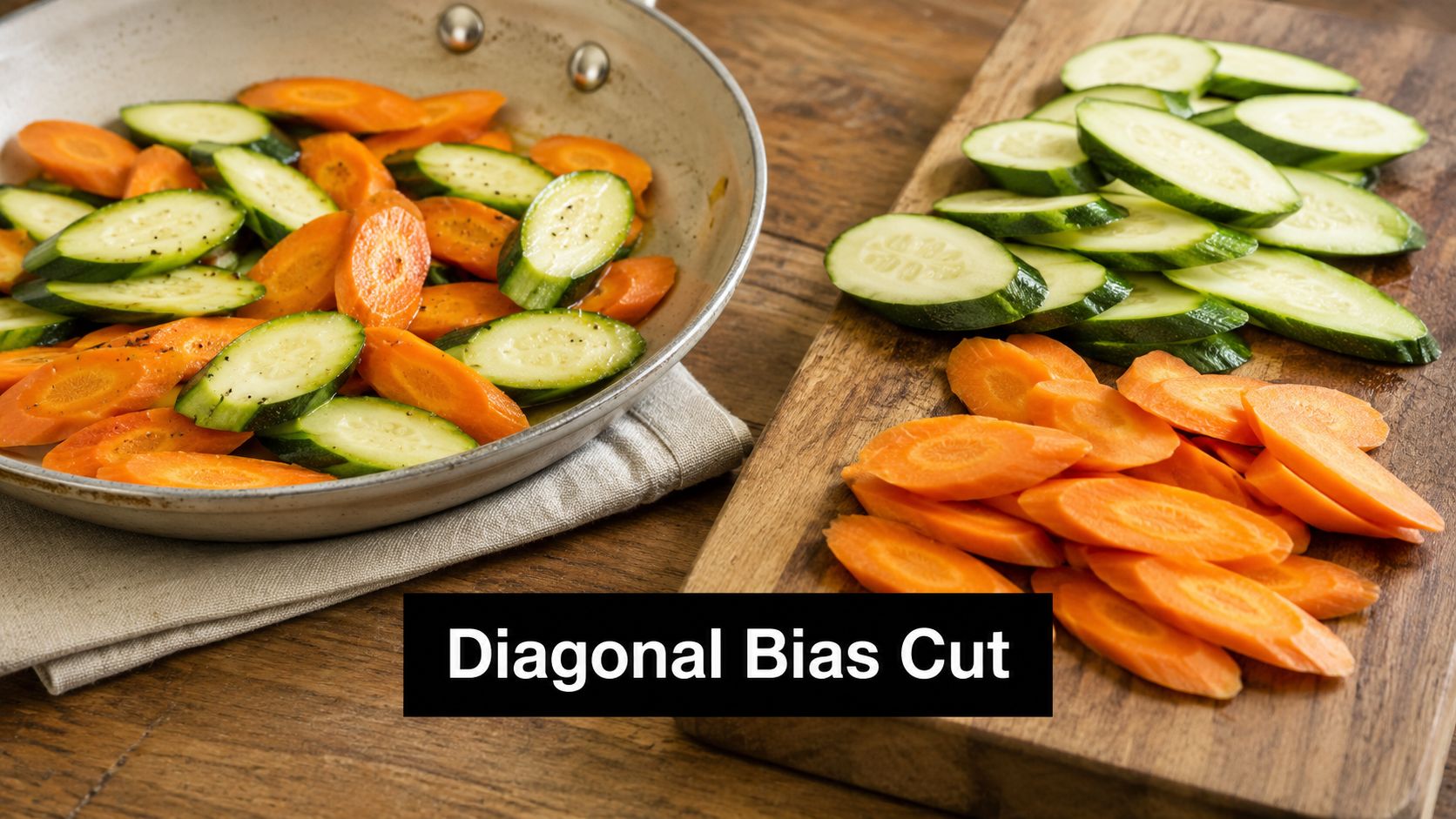
Carrots, zucchini, cucumbers, and leeks respond especially well to this shape. The cut gives long vegetables more visual presence without making them bulky, which is why it shows up so often in stir-fries, braises, and composed salads.
Why Angled Cuts Matter
The main advantage is control. A bias cut gives more surface area than a straight round slice, but it still leaves enough thickness for the vegetable to keep some structure. That trade-off matters. Thin rounds can go limp fast. Thick chunks stay firm but take longer to cook and often need more seasoning on the outside to taste balanced.
To make the cut, hold the knife at an angle and slice. Rotate the vegetable slightly after each cut if you want that classic roll-cut look, with pieces that stay consistent in size while exposing different faces. For quick weeknight cooking, I use a simple bias slice on carrots and zucchini. For braised dishes or soups where presentation counts more, the slight rotation is worth the extra few seconds.
Bias cuts also help with sauce distribution. Glaze, butter, vinaigrette, and pan sauce cling better to the broad surface, so the vegetables taste seasoned sooner and more evenly.
Start with a firm carrot or a thick zucchini. Soft, watery vegetables can slip if your angle is too shallow. If you save recipe notes in OrganizEat, mark when a dish works better with bias-cut vegetables instead of rounds. That one prep note can save a good stir-fry from turning patchy and overcooked the next time you make it.
9. Rondelle or Round Slice
Rondelle is simple, but simple doesn't mean careless. It's the classic round slice made perpendicular to the length of a cylindrical vegetable. Carrots in soup, cucumbers in salads, zucchini in sauté pans, and potatoes in gratins all rely on the same basic idea.
This is often the first cut people learn, and for good reason. It's fast, easy to read, and versatile across raw and cooked dishes. But thickness still matters, maybe more here than with any other basic cut.
Everyday Uses
Thin rounds cook quickly and can turn soft fast. Thicker rounds take longer but hold their shape and texture. That's why a cucumber salad wants a different rondelle than a simmered carrot side.
One chef-demonstration style guide groups commonly taught knife work into nine core shapes and gives approximate size ranges such as 1/8 to 1/4 inch for slices used for rounds or ribbons, which is a helpful benchmark when you're deciding how thin to go, as noted in the earlier knife guide reference.
A few practical adjustments help:
- Separate tapered ends: On carrots or parsnips, the skinny tail cooks much faster than the thick top.
- Match thickness to method: Thin for sautéing, thicker for simmering or roasting.
- Slice close to serving for raw salads: Cucumbers and radishes stay crisper that way.
Rondelle is a good cut to note directly in recipe titles inside your organizer. “Honey-glazed carrot rounds” tells you much more than “carrot side dish.”
10. Paysanne
A soup pot is where paysanne earns its place. The cut is flat, rustic, and shaped to fit the vegetable, but its primary goal is even cooking with less fuss than perfect cubes or sticks.
Paysanne usually starts from a slab or slice, then becomes small squares, triangles, circles, or diamonds depending on the ingredient. Carrots, celery, leeks, turnips, and potatoes all work well this way. Because the pieces are thin, they soften fairly quickly and release flavor into broths, braises, and sautéed vegetable mixes faster than larger chunks would.
The trade-off is clear. You gain speed and a more natural, generous look, but you lose the precise uniformity that matters in polished garnishes or tightly plated dishes. That is why paysanne belongs in hearty soups, home-style stews, and skillet dishes where texture should feel varied but not messy.
Thickness matters more than shape here. Keep the pieces close in thickness, and the pot stays balanced. Let some pieces run thick and others very thin, and you end up with a mix of mushy edges and undercooked centers.
I use paysanne when I want prep to move quickly without giving up control over the final dish.
It is also a smart cut for everyday recipe organization. In OrganizEat, note the cut directly in the recipe title or prep notes, such as “vegetable barley soup, carrots and turnips cut paysanne.” That small detail makes repeat cooking easier because you remember why the soup cooked on time and why the vegetables had the texture you wanted.
Paysanne teaches an useful kitchen lesson. A rustic cut still has a job to do. Shape affects cooking time, thickness affects texture, and both affect how flavor moves through the dish. Once you start seeing that connection, knife work stops being decorative and starts making dinner better.
Quick Comparison of 10 Vegetable Cuts
| Cut | Complexity 🔄 | Resources & Skill 💡 | Speed / Efficiency ⚡ | Outcomes 📊 | Key Advantages ⭐ |
|---|---|---|---|---|---|
| Julienne | Medium, requires precision and steady cuts | Sharp knife or mandoline; moderate knife skill | Fast cooking time; moderate prep time | Uniform thin matchsticks, even cooking, high surface area | Elegant presentation, great for stir-fries and salads |
| Brunoise | High, very time‑consuming and precise | Very sharp knife; advanced skill (julienne → dice) | Pieces cook very quickly; prep is slow | Extremely small uniform cubes that blend into sauces | Very refined look, ideal for fine dining garnishes |
| Chiffonade | Low–Medium, simple technique once learned | Sharp knife; rolled leafy herbs/greens | Quick after mastering technique | Delicate ribbons that retain herb identity | Minimizes bruising, striking herb garnish |
| Dice | Low–Medium, fundamental, scalable | Basic knife skills; guides optional | Moderate prep speed; varies by size | Standard cubes (various sizes), consistent cooking | Highly versatile across methods and recipes |
| Mince | Low, minimal precision required | Basic knife; rocking motion technique | Very fast to produce very fine pieces | Irregular tiny pieces, maximum flavor release | Best for aromatics; quick flavor infusion |
| Batonnet | Medium, requires uniform thickness | Sharp knife; steady hand | Moderate cooking speed; holds shape well | Thick uniform sticks that maintain integrity | Good structure for roasts, fries, braises |
| Allumette | Medium, consistency important | Mandoline recommended or sharp knife | Cooks quickly and fries well; moderate prep | Matchstick sticks slightly thicker than julienne | Ideal for frying/tempura and crisp textures |
| Oblique / Bias | Medium, needs angle control and rotation | Sharp knife; practice with rotation | Increases surface area so cooks faster; moderate prep | Diagonal elongated pieces, even cooking of cylinders | Visually appealing, good for Asian and plated dishes |
| Rondelle | Very Low, simplest cut | Basic knife or mandoline | Fastest to execute; cooking time varies by thickness | Round slices, easy and consistent with uniform diameter | Quick everyday cut for soups, salads, gratins |
| Paysanne | Very Low, informal and fast | Basic knife; no precision needed | Fastest cutting method overall | Flat, rustic irregular pieces suitable for homestyle dishes | Time‑saving, authentic rustic appearance for stews/soups |
Turn Your Kitchen Prep into a Practice
Mastering these types of vegetable cuts changes more than how your food looks. It changes how your cooking feels. Once you stop guessing at size and start cutting with intention, vegetables cook more predictably, pans stay easier to manage, and recipes stop surprising you for the wrong reasons.
You don’t need to learn everything at once. Start with dice, rondelle, and julienne. Those three alone cover a huge share of everyday cooking, from soups and tray bakes to salads and stir-fries. When those feel comfortable, add batonnet and chiffonade. Save brunoise for the days when you want to slow down and practice precision.
What works in a real home kitchen is repetition, not perfection. Cut carrots into rounds every week and you’ll improve. Dice onions for a few sauces and your spacing becomes more even. After a while, your hands begin to understand distance and thickness without much conscious effort. That’s when prep gets faster and more enjoyable.
It also helps to connect each cut to a cooking result. Julienne for speed. Batonnet for structure. Mince for quick flavor release. Paysanne for rustic efficiency. If you remember the purpose, you won’t have to memorize terminology in a vacuum.
A good organizer can make that practice stick. Saving recipes by cut type, adding notes like “small dice onion” or “bias-cut carrots,” and keeping photos of your best knife work gives you a personal reference library. That’s especially useful when you revisit a recipe months later and can’t remember how fine the vegetables should be or which version worked best.
OrganizEat fits that process naturally. You can save recipes from social media, handwritten cards, or websites, tag them by technique, and pull them up in Cooking Mode while you work. That means fewer greasy phone screens, fewer lost screenshots, and a much better chance that your practice turns into habit.
The payoff isn’t just that your vegetables look restaurant-perfect. It’s that dinner gets smoother. Your soups taste more balanced. Your stir-fries cook evenly. Your salads have better texture. Knife skills don’t make cooking rigid. They make it easier to cook with confidence and improvise when you need to.
If you want one place to save recipes, note the exact cuts that worked, store prep photos, and pull everything up while you cook, OrganizEat is built for that kind of kitchen life. It helps you turn scattered recipe inspiration into an organized, searchable system you’ll put to use.